
A clean workplace is easy to notice when something goes wrong. Overflowing trash, dusty surfaces, dirty restrooms, stained carpets, or an untidy break room can quickly change how employees and visitors experience a building. What is sometimes less obvious is how those conditions may also influence concentration, comfort, health, morale, and the ability to work effectively.
At First Service Janitorial, we look at workplace cleaning as more than making a building look presentable. Our goal is to help maintain clean, safe, welcoming environments where people can work and thrive. Our services are built around how each facility actually operates, including its traffic patterns, shared spaces, work schedules, and cleaning requirements.
Research into workplace environments supports a practical connection between cleanliness, indoor environmental quality, employee health, and work performance. Cleanliness is not the only factor affecting productivity, but maintaining the physical environment is one part of creating conditions that support employees instead of distracting them.
What Does Research Actually Say About Workplace Cleanliness and Productivity?
Research does not support the idea that cleaning an office automatically creates a specific percentage increase in productivity. Employee performance is influenced by many factors, including workload, leadership, job design, noise, temperature, lighting, workplace culture, and employee health.
However, research and workplace safety guidance consistently show that the physical work environment matters.
Good housekeeping can help create organized, uncluttered, hazard-free working conditions. Research into indoor workplaces has also connected environmental conditions with employee comfort, health symptoms, sickness absence, and performance impairment.
This gives facility managers a practical way to think about workplace cleanliness. Cleaning may support productivity through several interconnected pathways:
- Reducing distracting dirt, clutter, spills, and waste
- Maintaining clean and usable shared spaces
- Supporting better workplace hygiene
- Keeping restrooms and break rooms presentable
- Managing dust on surfaces and floors
- Maintaining carpets and hard flooring
- Addressing frequently touched shared surfaces
- Creating a professional environment that feels cared for
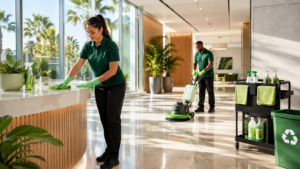
Our janitorial services are designed around many of these everyday requirements, including restroom cleaning, trash and recycling collection, floor care, break room cleaning, dusting, common-area presentation, and high-touch point wiping.
Why Can a Cleaner Workplace Make It Easier to Focus?
An employee who comes to work should be able to focus on the work they were hired to do, not on whether the restroom needs attention, whether trash is overflowing, or whether a shared area needs to be cleaned.
A consistently maintained environment removes some of these avoidable distractions.
This is especially important in offices with shared spaces. Conference rooms, reception areas, kitchens, restrooms, corridors, and common work areas may be used by dozens or hundreds of people throughout a working week.
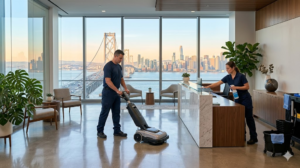
Our office building cleaning services can include:
- Lobby, entrance, and reception cleaning
- Restroom cleaning and restocking
- Break room and kitchen cleaning
- Meeting and conference room resets
- Vacuuming and mopping
- Trash and recycling collection
- Dusting desks, fixtures, and other surfaces
- High-touch surface disinfection
We typically build office cleaning around the way the workplace operates. After-hours service can reduce interference with normal operations, while day porter coverage can help higher-traffic facilities maintain cleanliness during the business day.
How Can Workplace Cleanliness Support Employee Health?
Productivity and employee well-being are closely connected. When workers are uncomfortable or dealing with workplace-related symptoms, it can become harder to concentrate and perform consistently.
Research into indoor work environments has identified relationships between workplace environmental quality and issues such as respiratory symptoms, irritation, headaches, fatigue, sickness absence, and performance impairment.
Cleaning is only one part of indoor environmental quality. Building ventilation, temperature, humidity, lighting, noise, moisture control, and other conditions matter too. Still, routine housekeeping has an important role in managing dust, debris, waste, dirty surfaces, and frequently used areas.
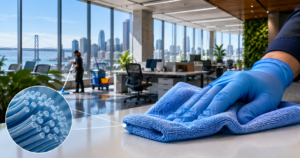
For facilities where additional hygiene attention is appropriate, our disinfection services focus on high-touch areas such as door hardware, shared counters, elevator buttons, handrails, restroom fixtures, break room surfaces, conference areas, and shared equipment when requested.
Cleaning and disinfection are different steps. Routine cleaning removes dirt and organic matter, while disinfection is used on appropriate surfaces to reduce pathogens after cleaning. We build the frequency around the needs of the facility rather than treating every building exactly the same.
Why Do Restrooms, Break Rooms, and Shared Areas Matter So Much?
Shared spaces often create some of the strongest impressions employees have about workplace cleanliness.
An employee may spend most of the day at a desk, but everyone still notices a restroom that has not been maintained properly or a break room with overflowing trash and dirty surfaces.
These areas also receive frequent traffic and repeated use throughout the day.
A recurring cleaning program can address tasks such as:
- Sanitizing and restocking restrooms
- Emptying trash and recycling
- Cleaning break room surfaces
- Cleaning appliance exteriors
- Wiping frequently touched areas
- Maintaining entrances and common spaces
- Vacuuming, sweeping, and mopping floors
At First Service Janitorial, we define these tasks according to each building’s actual needs. Our goal is to establish a consistent cleaning scope instead of relying on irregular cleaning whenever a problem becomes noticeable.
Facility managers can also explore the different commercial facilities we serve because cleaning requirements can vary significantly between offices, schools, healthcare environments, financial workplaces, retail facilities, gyms, hospitality properties, and industrial spaces.
How Can Floor, Carpet, and Surface Care Affect the Workplace?
Routine cleaning is important, but some surfaces eventually require more than everyday maintenance.
Commercial carpets collect soil through repeated foot traffic. Hard floors can become dull or worn. Tile and grout can require deeper cleaning. Glass and windows also influence how clean and well-maintained a facility appears.
Our commercial care services go beyond routine janitorial maintenance and can include:
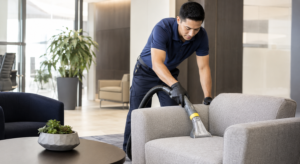
- Carpet cleaning and hot water extraction
- Upholstery and fabric partition cleaning
- Tile and grout deep cleaning
- Hard floor stripping, sealing, and refinishing
- Floor buffing, burnishing, and polishing
- Concrete and VCT floor maintenance
- Interior and exterior window cleaning
These services can complement recurring janitorial care when a facility needs periodic deeper maintenance.
From a productivity perspective, the goal is simple. Employees should be able to arrive at a workplace that feels maintained, functional, and ready for the day rather than being distracted by cleaning problems that have been allowed to accumulate.
How Often Should a Workplace Be Professionally Cleaned?
There is no single cleaning schedule that is appropriate for every workplace.
The right frequency depends on factors such as:
- Number of employees
- Daily foot traffic
- Facility type
- Number of shared spaces
- Restroom usage
- Client and visitor traffic
- Operating hours
- Industry-specific hygiene requirements
Many offices require recurring service several times per week, while higher-traffic facilities may need daily attention. Lower-traffic professional offices may require less frequent service.
That is why we start by understanding the building rather than applying the same cleaning schedule everywhere.
Our coverage extends across commercial facilities in the Bay Area, and businesses can review our service areas when considering recurring cleaning support.
When Can a One-Time Deep Clean Help Reset a Workplace?
Sometimes the problem is not the recurring schedule. A workplace may simply need a more thorough reset.
Construction work, tenant turnover, seasonal buildup, an upcoming event, or accumulated dust and soil can create cleaning needs beyond normal maintenance.
Our one-time cleaning services can be used for situations including:
- Post-construction cleanup
- Move-in or move-out cleaning
- Pre-event and post-event cleaning
- Seasonal deep cleaning
- Property inspection preparation
- First-time deep cleaning before recurring service
A deep clean can establish a stronger baseline. Recurring janitorial cleaning can then help maintain that condition over time.
How Do We Build Cleaning Around a More Productive Workplace?
We believe consistency matters more than waiting for visible problems.
Our process begins by looking at the facility, its traffic, its working hours, and the standard that needs to be maintained. From there, we can define the cleaning scope, schedule, team requirements, and quality checkpoints.
A productivity-supportive cleaning plan may combine:
- Routine janitorial service for everyday facility maintenance.
- High-touch cleaning or disinfection where appropriate.
- Day porter support when heavily used areas need attention during working hours.
- Periodic commercial care for carpets, floors, tile, upholstery, and windows.
- One-time deep cleaning when the facility requires a complete reset.
- Regular inspections to help ensure the agreed cleaning standard is being maintained.
This approach reflects how we operate at First Service Janitorial. We build cleaning programs around the facility rather than expecting the facility to adapt to a generic cleaning schedule.
How Can First Service Janitorial Help Create a Cleaner Workplace?
A productive workplace requires much more than cleaning, but employees should not have to work around preventable cleanliness problems.
At First Service Janitorial, we provide commercial cleaning and janitorial services designed to help businesses maintain clean, safe, and welcoming environments. We are licensed, insured, and bonded, and our service options include flexible scheduling for nightly janitorial work, daytime porter coverage, and specialty cleaning.
If your facility has recurring cleanliness problems, inconsistent janitorial coverage, neglected floors, dirty shared areas, or a need for deeper cleaning, we can assess what is happening and build a scope around the way your facility actually operates.
You can request a cleaning evaluation or custom quote to discuss the condition of your workplace and determine what level of service makes sense.
Which Organizations Support These Findings?
Centers for Disease Control and Prevention, National Institute for Occupational Safety and Health. “Office Environments and Your Safety.” National Institute for Occupational Safety and Health, 3 Mar. 2026. The guidance explains that maintaining a healthy office environment requires attention to the physical environment and other workplace factors that affect employee safety and comfort.
Centers for Disease Control and Prevention, National Institute for Occupational Safety and Health. Indoor Work Environments and Health: A Research Agenda. The report discusses relationships among indoor work environments, employee health, sickness absence, and performance impairment.
Occupational Safety and Health Administration. Working With the Shipyard Industry: Process, Housekeeping Safety. The guidance identifies good housekeeping as a factor affecting worker safety, health, morale, productivity, and effective use of workplace space.
United States Environmental Protection Agency. “An Office Building Occupant’s Guide to Indoor Air Quality.” The guidance notes that improved indoor environmental quality can contribute to higher productivity and fewer lost workdays while emphasizing that indoor conditions involve multiple interacting factors.