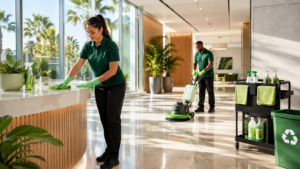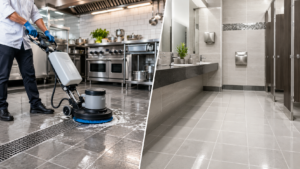
Facility cleaning plans often focus on floors, restrooms, windows, waste removal, and hard surfaces. Those areas matter, but upholstered furniture and other fabric-covered surfaces also receive daily contact. Office chairs, lobby seating, conference-room furniture, privacy panels, curtains, and fabric wall features can collect dust, crumbs, body oils, spills, and tracked-in soil.
At First Service Janitorial, we include carpet and upholstery cleaning within our commercial care services. We view fabric care as part of a complete facility plan, not simply a cosmetic task to postpone until furniture looks heavily stained.
Why Is Commercial Upholstery Cleaning Often Overlooked?
Upholstery can hide soil better than many hard surfaces. A desk may show dust quickly, while a patterned chair can look acceptable even after soil has settled into its fibers, seams, and cushion edges. Because the change happens slowly, facility teams may not notice it until stains, dull areas, or odors become obvious.
Furniture can also fall between routine and specialty cleaning responsibilities. Daily service may cover floors and hard surfaces, while deeper furniture care is left for an undefined later date. Our janitorial and office cleaning services can be coordinated with periodic commercial care so upholstered surfaces are not forgotten.
Which Fabric Surfaces Should Be Included in Facility Care?
A facility inspection should look beyond the lobby sofa. Common textile surfaces include:
- Reception, desk, conference-room, and lounge seating
- Auditorium or event seating
- Fabric-covered partitions and acoustic panels
- Curtains, drapes, removable cushions, and fabric wall features
Seating used all day may require attention sooner than decorative furniture in a low-traffic room. Our industries we serve page includes offices, schools, event venues, gyms, hospitality spaces, industrial facilities, and retail establishments, each with different traffic and scheduling needs.
What Can Build Up on Commercial Upholstery?
Commercial furniture receives repeated contact from clothing, hands, bags, food, drinks, and airborne dust. Particles settle into seams and cushion gaps, while oils and spills may darken fabric or leave residue.
Unapproved spot cleaning can create water marks, spread a stain, leave residue, or change texture. We therefore base upholstery care on inspection, testing, suitable cleaning chemistry, controlled agitation, and moisture management.
How Should Commercial Upholstery and Fabric Be Cleaned?
Professional upholstery care begins with the material and construction of the item. The correct method depends on fiber type, color stability, backing, cushions, soil level, and manufacturer guidance. Professional upholstery standards also recognize that different materials require different cleaning methods.
How Do We Start With Inspection and Testing?
We identify the furniture included in the work and note stains, worn areas, fading, loose seams, and pre-existing damage. Care labels and available manufacturer instructions should be reviewed.
A small, inconspicuous test area may help evaluate color transfer, texture change, or another unwanted reaction. Furniture requiring specialized restoration should not be treated like routine office seating.
Scheduling is also part of the inspection. We consider room access, noise, ventilation, and drying time. Our one-time commercial cleaning services may be useful before an event, after a busy season, during a move, or when a facility needs a focused deep clean.
How Are Dry Soil and Debris Removed?
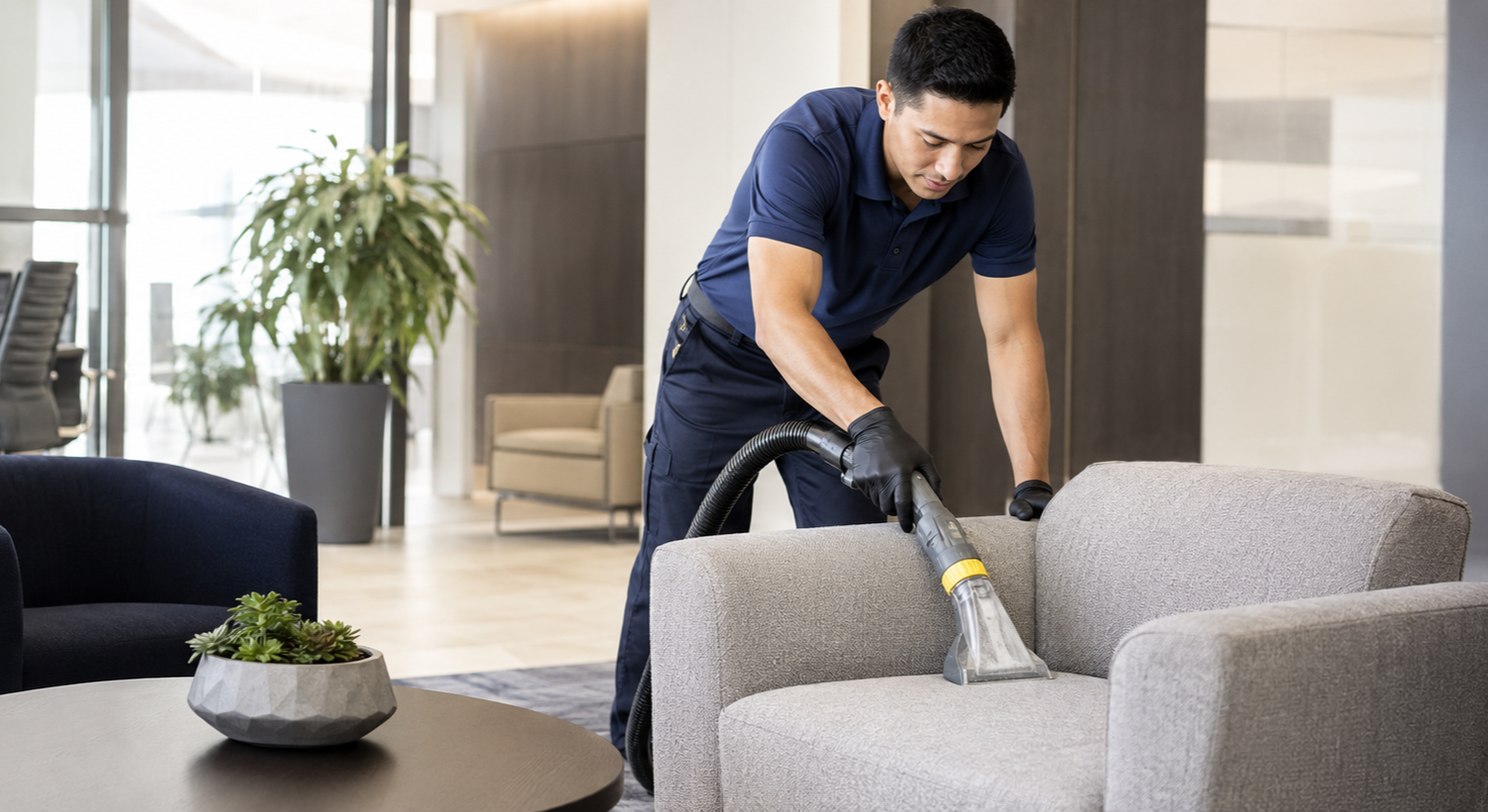
Appropriate vacuuming can remove loose dust, crumbs, hair, and debris before moisture or cleaning solution is introduced. Seams, creases, cushion edges, and areas beneath removable cushions deserve close attention.
This principle is similar to commercial carpet maintenance, where routine dry soil removal supports the broader care program. Upholstery and carpet are different surfaces, but both benefit from timely vacuuming.
How Should Spots and Stains Be Handled?
Spots should be identified as carefully as possible before treatment. A drink spill, oily residue, ink mark, food spot, and unknown stain may require different decisions.
Blotting is generally safer than aggressive rubbing for a fresh spill. Staff should avoid experimenting with several chemicals because excessive moisture and mixed residues can complicate professional cleaning. Any product used must be appropriate for the surface and applied according to its label.
No responsible cleaning plan should guarantee removal of every stain. Results depend on the material, age of the spot, prior treatment, fabric condition, and whether the substance permanently changed the fiber or dye.
How Is the Cleaning Method Selected?
Upholstery may require a low-moisture method, extraction, foam-based cleaning, a dry-solvent approach, or another process suitable for the fabric. The method should match the item rather than being selected only for speed.
Moisture control matters because excess liquid can move soil deeper, affect backing materials, create water marks, or increase drying time. Delicate fibers, unstable dyes, and certain furniture constructions may require a cautious process or specialized care.
Cleaning and disinfection are separate tasks. When a facility has a specific disinfection need, only a product approved for the intended soft surface should be considered and used according to its label. Public health guidance likewise recommends using cleaners appropriate for soft surfaces. Our commercial disinfection services can be planned according to the surface and facility need.
Why Does Complete Drying Matter?
Furniture should not return to normal use until it is adequately dry. Air movement, ventilation, humidity, fabric thickness, cushion construction, and the amount of moisture used can affect drying time.
A practical plan may involve cleaning furniture in sections, rotating available seating, or scheduling after hours. Staff should know which items are temporarily unavailable and when they can be used again.
How Often Should Commercial Upholstery Be Cleaned?
There is no single schedule for every facility. Frequency should reflect traffic, fabric type, visible condition, spill history, business standards, and how the space is used.
A practical program may include:
- Frequent visual checks in reception and waiting areas
- Prompt reporting and response for new spills
- Routine vacuuming based on traffic
- Periodic professional cleaning for heavily used seating
- Less frequent deep cleaning for low-use furniture
- Additional service before events or seasonal peaks
High-traffic seating may need professional attention sooner than furniture in private rooms. Food areas, employee lounges, schools, hospitality spaces, and public waiting areas may also require closer monitoring.
We recommend establishing the schedule after reviewing the facility. Managers can book an evaluation call to discuss furniture, traffic, existing cleaning coverage, and expected results.
Which Facilities Benefit Most From Fabric Care?
Any business with upholstered seating can benefit from a maintenance plan. Offices, schools, waiting rooms, event venues, hospitality facilities, retail spaces, and gyms all use fabric surfaces differently. Traffic, spill risk, access, and presentation needs vary, so we tailor the plan rather than applying one fixed schedule.
How Can Fabric Care Fit Into a Complete Cleaning Program?
Upholstery cleaning works best when connected to routine janitorial work, carpet care, hard floor maintenance, restroom sanitation, window cleaning, and periodic deep cleaning.
Sequencing matters. Dust-producing work should occur before final fabric cleaning, while carpet and upholstery service may be coordinated when access and drying conditions allow. We assess the property and build the plan around its actual use and schedule.
Why Should Commercial Upholstery Care Be Professionally Planned?
Commercial upholstery requires more judgment than wiping a hard surface. Textiles can react differently to water, agitation, heat, solvents, and cleaning products. Furniture construction can also limit which procedures are appropriate.
A professional plan helps reduce avoidable problems such as color transfer, overwetting, residue, texture changes, and unnecessary downtime. It also gives facility managers a defined scope, a workable schedule, and one point of coordination.
At First Service Janitorial, our commercial care services extend beyond routine maintenance. We support Bay Area facilities with tailored cleaning programs that can include carpet and upholstery cleaning, floor care, window cleaning, and related services shown on our website.
How Can First Service Janitorial Help?
We begin by learning how the facility is used. We consider traffic, furniture type, visible condition, access, scheduling, and the other services included in the cleaning plan. We can then recommend a suitable scope without adding unnecessary work or making unsupported promises.
Upholstery and fabric cleaning may be scheduled as a focused service or coordinated with ongoing janitorial and commercial care. To discuss your property, use our commercial cleaning quote form.
Which Organizations Inform These Cleaning Practices?
Centers for Disease Control and Prevention. “When and How to Clean and Disinfect a Facility.” CDC, 16 Apr. 2024.
Institute of Inspection, Cleaning and Restoration Certification. ANSI/IICRC S300 Standard for Professional Upholstery Cleaning. IICRC, 2025.
Occupational Safety and Health Administration. Protecting Workers Who Use Cleaning Chemicals. U.S. Department of Labor.
United States Environmental Protection Agency. “Guidance for Products Including or Adding Disinfectant Efficacy Claims for Use on Soft Surface Textiles in Clinical and Institutional Settings.” EPA.