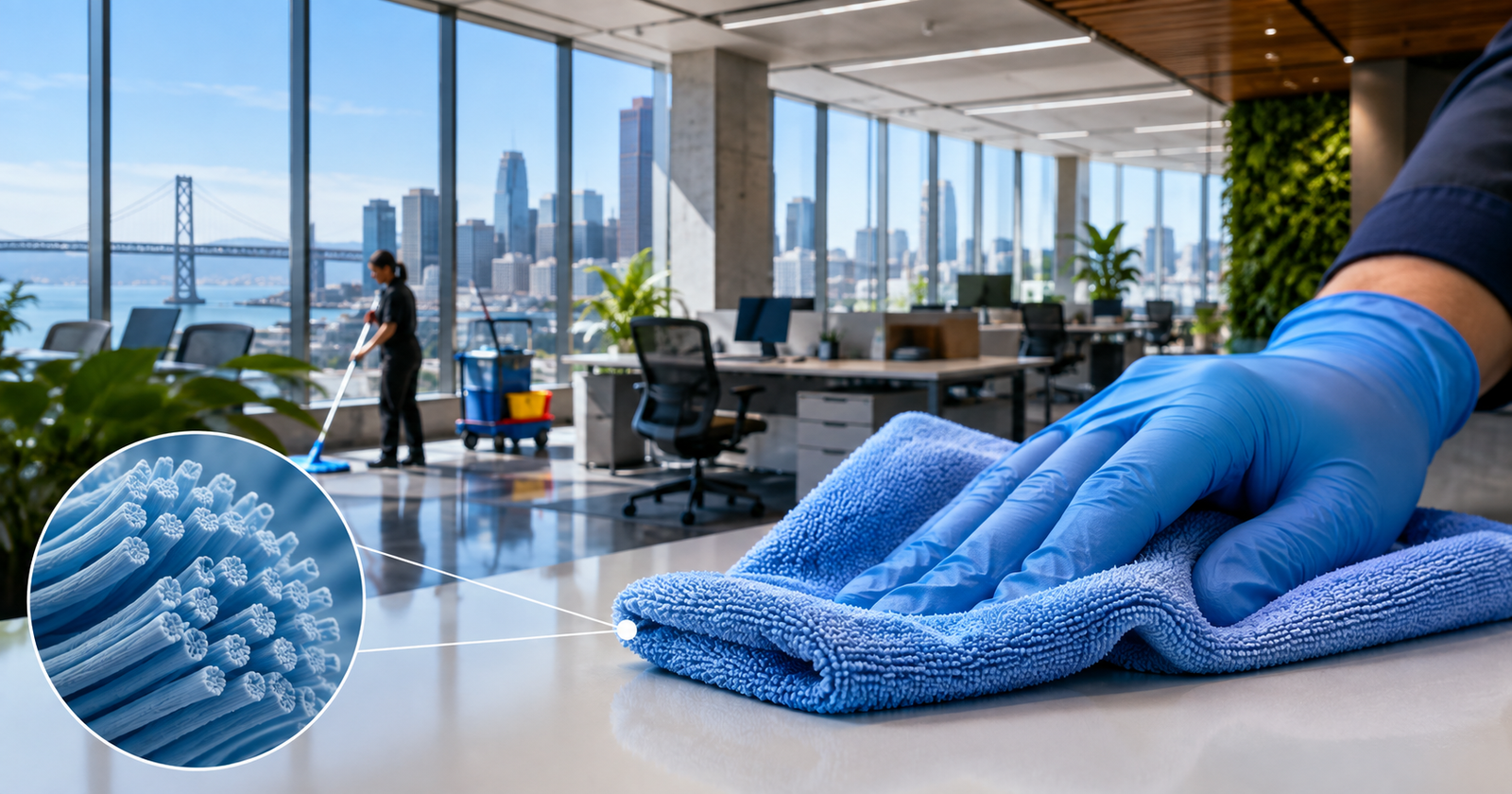
Clean offices are not just about making desks look tidy or floors appear polished. The tools used during cleaning can influence how effectively dust, oils, soil, and microorganisms are removed from workplace surfaces. One tool that has become especially important in modern professional cleaning is microfiber.
At First Service Janitorial, we focus on helping Bay Area businesses maintain clean, organized, and professional workplaces through janitorial and office cleaning services. Our service scope includes office cleaning, floor and carpet care, restroom sanitation, window cleaning, surface disinfection, kitchen cleaning, and other facility needs.
Microfiber technology fits naturally into the broader discussion about better cleaning outcomes because its physical structure can help capture dirt and microorganisms rather than simply moving debris across a surface. Public health guidance also recognizes microfiber as a useful cleaning material when it is selected, maintained, and used correctly.
What Makes Microfiber Different From Traditional Cleaning Materials?
Microfiber is a synthetic material made with extremely fine fibers. When cleaning-grade microfiber is split into very small strands, those fibers create significantly more surface area than a conventional cloth.
That structure matters because cleaning depends heavily on physical removal. Microfiber can pick up and hold dust, grease, soil, and other material as the cloth passes across a surface. The U.S. Environmental Protection Agency notes that microfiber cleaning cloths and mops can remove organic matter such as dirt, oils, and grease, along with germs on surfaces.
For an office building, that characteristic can be useful on surfaces such as:
- Desks and workstations
- Counters
- Door handles
- Tables
- Breakroom surfaces
- Restroom fixtures
- Interior glass
- Other frequently touched hard surfaces
These are also the types of areas commonly addressed through our broader commercial care services, which include routine office and facility cleaning, floor and carpet care, restroom sanitation, window and glass cleaning, and flexible scheduling.
How Can Microfiber Improve the Removal of Dust and Everyday Soil?
Dust is one of the most visible cleaning challenges in an office, but simply pushing dust from one location to another does not produce a consistently clean result.
Microfiber can improve mechanical removal because its fine fibers provide a large surface area for capturing particles. The California Department of Public Health identifies microfiber as an effective cleaning technology and notes evidence showing that it can provide improved cleaning while using less water and cleaning chemicals in some applications.
That makes microfiber particularly useful when cleaning areas where fine particles accumulate, such as desktops, ledges, furniture, fixtures, and other horizontal surfaces.
It is important, however, to recognize that no cloth automatically guarantees a clean building. Results also depend on technique, cleaning frequency, appropriate products, laundering, staff training, and whether cleaners consistently cover the areas included in the facility’s cleaning plan.
For this reason, cleaning quality should be evaluated as a complete process rather than by looking at a single tool. Facility managers can also review our guide on janitorial inspection checklists for California office buildings when thinking about overall cleaning accountability.
Why Does Microfiber Matter for High-Touch Office Surfaces?
High-touch surfaces deserve special attention because they are handled repeatedly throughout the workday.
The Centers for Disease Control and Prevention recommends regularly cleaning frequently touched surfaces such as counters, door handles, stair rails, elevator buttons, touchpads, restroom fixtures, and desks. The organization also explains that visibly dirty surfaces should be cleaned before sanitizing or disinfecting because dirt can interfere with the effectiveness of those later steps.
Microfiber can support this process by providing strong mechanical wiping action before or as part of an appropriate cleaning procedure.
How Does Mechanical Wiping Contribute to Better Cleaning?
Cleaning is not simply a matter of applying a chemical to a surface.
Physical wiping helps loosen and remove soil. The Centers for Disease Control and Prevention recommends using mechanical action during cleaning and systematically rotating or unfolding cleaning cloths so that clean portions of the material continue to contact the surface.
That principle is especially relevant in office buildings because cleaners may move through many workstations, common areas, restrooms, and shared spaces during a single service visit.
Using a contaminated section of cloth over too many surfaces can work against the goal of thorough cleaning. Proper cloth management is therefore just as important as the material itself.
Can Microfiber Replace Disinfection in an Office Building?
Microfiber and disinfection should not automatically be treated as interchangeable.
Microfiber is primarily a cleaning tool. Disinfection is a separate process used when a facility, surface, or situation calls for it.
The Centers for Disease Control and Prevention explains that cleaning should generally occur before sanitizing or disinfecting because removing dirt and impurities helps disinfectants work properly.
This distinction aligns with our own disinfection services. Our website explains that visibly dirty surfaces are cleaned before disinfectants are applied and that disinfecting products are used according to applicable product instructions, including contact time and other requirements.
When Should Offices Think Beyond Routine Cleaning?
Routine cleaning may be appropriate for many normal office surfaces, while additional disinfection may make sense depending on the circumstances, occupancy, surface use, and facility requirements.
The key is not to use more chemicals simply because they are available. It is to choose the right cleaning procedure for the specific surface and situation.
For facilities that need more intensive attention rather than normal recurring service, we also offer one-time commercial cleaning. That service can include dusting and wiping horizontal and vertical surfaces, restroom cleaning, interior glass cleaning, breakroom cleaning, trash removal, and related commercial cleaning tasks.
How Can Microfiber Support Greener Office Cleaning Practices?
Improving cleaning outcomes does not necessarily mean increasing chemical use.
One reason microfiber receives attention in greener cleaning programs is its ability to remove soil mechanically. The U.S. Environmental Protection Agency has recommended microfiber cleaning cloths and similar tools as one way to help minimize the amount of cleaning product used in greener facility-maintenance programs.
The California Department of Public Health also identifies microfiber as a tool that can help reduce exposure to cleaning chemicals for routine cleaning applications.
This connects well with our own focus on environmentally conscious janitorial solutions. Our Bay Area janitorial services include green cleaning options designed to support healthier workplaces and sustainability.
The goal should still be appropriate cleaning rather than simply using the least possible product. Surface condition, manufacturer instructions, facility requirements, and any need for disinfection must remain part of the decision.
Why Is Proper Microfiber Handling Just as Important as the Cloth Itself?
Microfiber performs best when it is properly maintained.
Reusable cleaning cloths can become a source of cross-contamination if they are repeatedly used without proper handling or laundering. The Environmental Protection Agency notes that a laundering program is necessary when microfiber is reused because proper laundering helps prevent transferring germs between surfaces.
The Centers for Disease Control and Prevention similarly advises that reusable mops and cleaning cloths be cleaned after use and allowed to dry before reuse.
This means professional cleaning programs should think about the entire microfiber lifecycle:
- How clean cloths are stored
- How many cloths are available for a cleaning shift
- When a cloth should be replaced during cleaning
- How used cloths are separated
- How reusable materials are washed
- How cloths are dried and stored before their next use
Microfiber is therefore not a shortcut. It is most effective when incorporated into a disciplined cleaning process.
How Can Microfiber Support More Consistent Office Cleaning Results?
Consistency is one of the biggest challenges in commercial cleaning.
A building can look excellent after one service and then gradually decline if procedures are inconsistent. Better tools help, but repeatable cleaning standards matter even more.
Our approach to commercial cleaning for different industries includes office buildings, where our focus is keeping workplaces organized, sanitized, professional, and ready for daily use.
Microfiber can support consistency because cleaners can use it as part of systematic wiping procedures for common surfaces. When paired with clear cleaning routes, appropriate cloth changes, proper products, and quality checks, the technology becomes one part of a larger cleaning system.
Why Should Facility Managers Still Inspect the Results?
Even a strong cleaning process needs verification.
Facility managers should pay attention to recurring signs that cleaning procedures may need adjustment, including visible dust, fingerprints, restroom buildup, neglected corners, inconsistent floor appearance, or frequently missed touchpoints.
The objective should not be to ask whether microfiber is being used simply because it is a popular cleaning technology. A more useful question is whether the entire cleaning process consistently delivers the results the facility requires.
Where Does Microfiber Fit Into a Complete Office Cleaning Program?
Office cleaning requires far more than wiping desks.
Our professional janitorial services can address multiple parts of a commercial facility, including:
- Carpet care
- Restroom sanitation
- Window cleaning
- Trash and recycling
- Surface disinfection
- Kitchen and breakroom cleaning
- Routine office cleaning
- Floor care
These services can be customized around the needs and schedule of the facility.
For example, microfiber may be useful for wiping hard surfaces, but carpeting requires an entirely different maintenance approach. Facility managers dealing with carpeted offices can review our commercial carpet maintenance guide for additional information about maintaining those surfaces.
Effective office cleaning comes from matching the cleaning method to the surface rather than expecting one tool to handle every task.
How Can Bay Area Businesses Build a Better Office Cleaning Plan?
A good cleaning plan begins with the building itself.
Every workplace has different traffic levels, layouts, surfaces, schedules, and priorities. A small professional office does not necessarily require the same cleaning frequency or procedures as a large multi-floor commercial property.
We recommend considering:
- Which spaces receive the most daily traffic
- Which surfaces are touched most often
- Which areas become visibly dirty fastest
- Whether restrooms and breakrooms need additional attention
- What floor types are present
- Whether specialty cleaning is required
- When cleaning can occur with the least disruption
- How cleaning quality will be inspected
Our services are designed to be adaptable to the individual needs of offices and commercial facilities throughout the Bay Area.
If you are reviewing your current office cleaning program, you can request a custom cleaning quote or schedule a cleaning evaluation call. We can look at your facility requirements and help determine what kind of professional cleaning support makes sense for your workplace.
Which Organizations Support the Cleaning Principles Discussed Here?
California Department of Public Health. “Cleaning for Asthma-Safe Schools Microfiber Challenge.” California Department of Public Health. The department explains that microfiber can remove dust, dirt, and germs during routine cleaning while reducing reliance on cleaning chemicals.
California Department of Public Health. “Environmental Cleaning: Effective Cleaning Strategies.” California Department of Public Health, 30 Apr. 2024. The department discusses microfiber as an environmental cleaning technology and reports advantages related to cleaning effectiveness and resource use.
Centers for Disease Control and Prevention. “Cleaning Supplies and Equipment.” Healthcare-Associated Infections, 19 Mar. 2024. The guidance discusses microfiber cloths and mop heads and their capacity to collect dirt and microorganisms.
Centers for Disease Control and Prevention. “Environmental Cleaning Procedures.” Healthcare-Associated Infections, 19 Mar. 2024. The guidance describes systematic cloth use, mechanical cleaning action, and rotating clean cloth surfaces during environmental cleaning.
Centers for Disease Control and Prevention. “When and How to Clean and Disinfect a Facility.” Centers for Disease Control and Prevention. The guidance explains the importance of regularly cleaning high-touch surfaces and cleaning before sanitizing or disinfecting.
United States Environmental Protection Agency. “What’s So Great About Microfiber?” Green Cleaning, Sanitizing, and Disinfecting: A Toolkit for Early Care and Education. The fact sheet explains microfiber’s structure, mechanical cleaning properties, reusability, and proper laundering considerations.
United States Environmental Protection Agency. “Appendix A: Model Program for the State School Environmental Health Guidelines.” United States Environmental Protection Agency. The agency includes microfiber tools among practices that can help minimize the amount of cleaning product used.