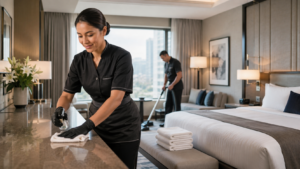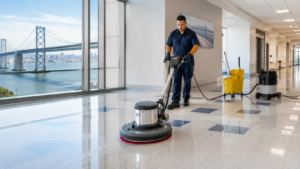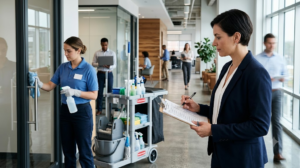
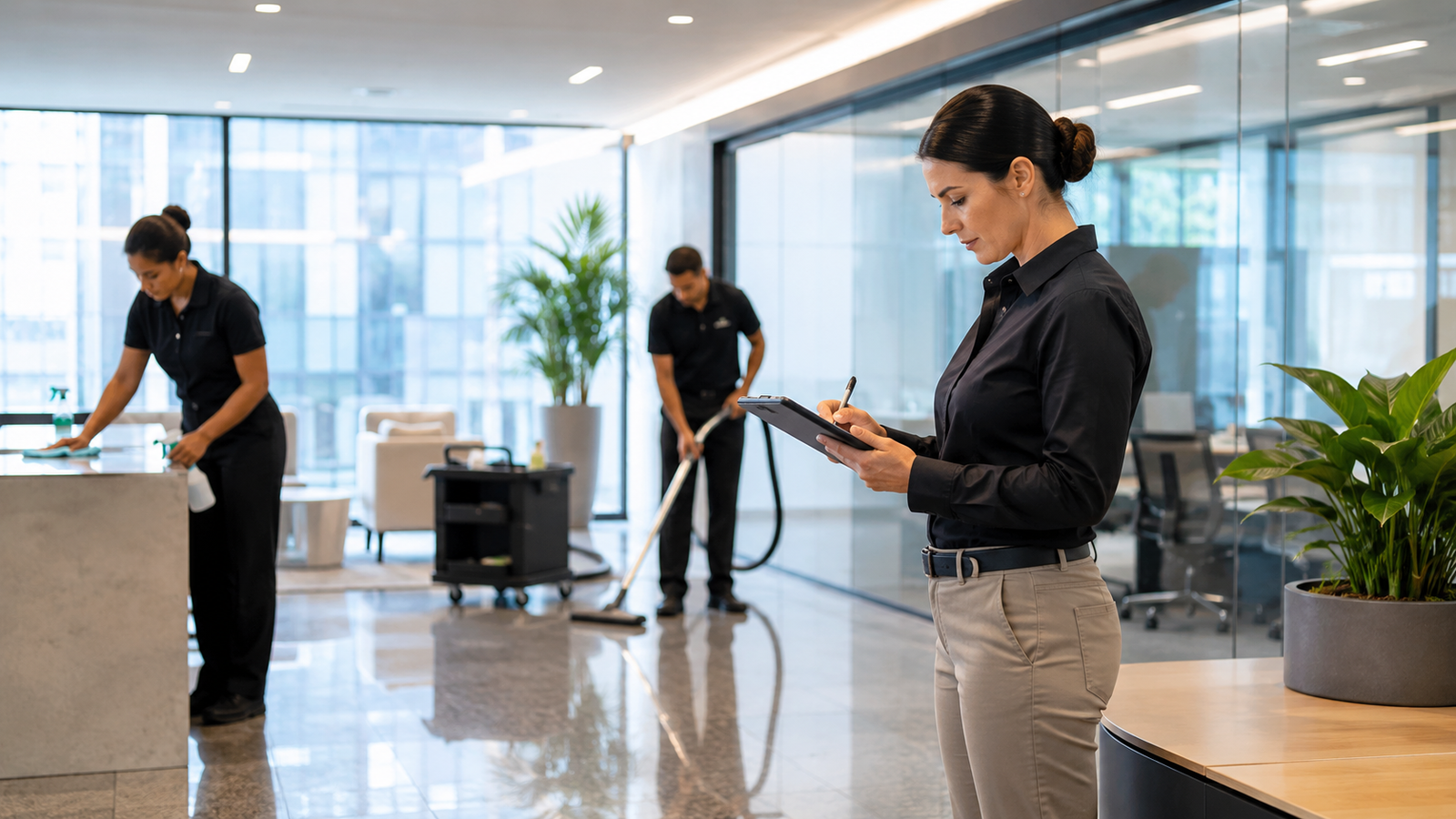
A clean building should not depend on whether a particular cleaner happens to have a good night. Professional janitorial service should be consistent, repeatable, and built around clear expectations.
At First Service Janitorial, we believe quality starts with understanding the facility, its schedule, its high-priority areas, and what the client expects to see after every service. From there, the work needs to be performed carefully, reviewed, communicated, and adjusted when necessary.
That is what janitorial quality control is really about.
It is not simply walking through a building after cleaning and checking whether the floors look good. Effective quality control connects the cleaning plan, the people performing the work, the condition of the facility, and the client’s expectations.
Our Janitorial Services approach is built around tailored cleaning solutions, dependable service, clear communication, and attention to the needs of each facility. Quality control helps turn those principles into a consistent cleaning experience.
What Does Quality Control Mean in a Professional Janitorial Company?
Quality control is the process of making sure cleaning work consistently matches the agreed scope and expectations of the facility.
A professional janitorial company should know what needs to be cleaned, how it should be cleaned, which areas require additional attention, and what a satisfactory result should look like.
That can include checking:
- Floors and carpeted areas
- Restrooms and fixtures
- Trash and recycling areas
- Desks and common surfaces included in the scope
- High-touch surfaces
- Breakrooms and kitchens
- Interior glass and windows
- Entryways and common areas
- Cleaning supplies or restroom supplies when restocking is included
The purpose is not to make cleaning unnecessarily complicated. The purpose is to create consistency.
When responsibilities are clear, cleaners know what is expected and facility managers have a practical way to evaluate whether those expectations are being met.
Why Should Quality Control Start Before Cleaning Begins?
Quality problems often begin before anyone picks up a mop or cleaning cloth.
Every commercial facility is different. An office building does not operate exactly like a school, gym, healthcare facility, retail establishment, event venue, or hospitality property. The amount of traffic, type of surfaces, operating hours, sensitive areas, and cleaning priorities may all differ.
That is why we emphasize cleaning programs tailored to the facility rather than treating every property exactly the same.
Our Industries We Serve information reflects this approach. We work with different facility types that can have very different cleaning priorities.
How Should a Facility-Specific Cleaning Plan Support Quality?
A useful cleaning plan should establish what work needs to be completed and where the greatest attention is required.
Depending on the facility, that may involve:
- Identifying high-traffic areas
- Prioritizing restrooms and common spaces
- Determining which surfaces require routine cleaning
- Identifying high-touch areas that may need additional attention
- Establishing floor and carpet care requirements
- Planning cleaning around operating hours
- Identifying specialty cleaning that falls outside routine janitorial work
The clearer these expectations are at the beginning, the easier it becomes to evaluate cleaning quality later.
What Should Cleaners Be Checking During Each Service?
Good quality control starts with the people performing the cleaning.
Our janitorial services include work such as carpet care, restroom sanitation, window cleaning, trash and recycling, surface disinfection, and kitchen cleaning. Each of those areas has its own signs that the work was completed properly.
For example, restroom quality should involve more than checking whether the room smells clean. Fixtures, sinks, partitions, floors, touchpoints, trash receptacles, and other included areas should receive appropriate attention.
Floor quality should not be judged only from the doorway. Corners, edges, visible soil, traffic patterns, and the condition of the particular flooring surface matter.
High-touch surfaces deserve deliberate attention because they are handled frequently throughout the day.
Professional cleaners should understand what areas belong within the cleaning scope rather than simply cleaning whatever catches their attention first.
How Do Janitorial Inspections Improve Cleaning Quality?
Inspections provide another level of accountability.
A Janitorial Inspection Checklist can help turn subjective impressions into more organized observations. Instead of simply asking whether a building “looks clean,” an inspection can examine specific areas and identify where the result may need improvement.
An inspection might evaluate:
- Restroom condition
- Floor appearance
- Carpet cleanliness
- Trash removal
- Common areas
- High-touch surfaces
- Interior glass
- Breakroom or kitchen areas
- Visible dust or debris
- Areas that were missed or require follow-up
This matters because small problems can easily become recurring problems when nobody identifies them.
A missed corner once may be an isolated issue. The same corner being missed repeatedly suggests that the cleaning process or expectations need to be reviewed.
Quality control helps identify the difference.
How Does Training Affect Janitorial Quality Control?
A checklist is only useful when the cleaning team understands how to perform the work behind each item.
Training and professional protocols help establish consistency between workers and cleaning visits.
For our One-Time Cleaning Services, our website specifically notes that our team follows professional protocols designed to support uniform quality. The same principle is important throughout commercial cleaning.
Cleaning staff should understand the proper approach for the surfaces and spaces they are responsible for cleaning.
They also need to recognize that different materials may require different methods. Carpet, glass, hard flooring, tile, grout, upholstery, and sensitive surfaces should not automatically receive the same treatment.
That knowledge becomes especially important when routine janitorial cleaning transitions into more specialized facility care.
How Should Quality Control Handle Problems or Missed Areas?
No quality-control process should assume that problems will never occur.
The real test is what happens when an issue is found.
Professional quality control should make it easy to:
- Identify the problem.
- Determine whether it falls within the agreed cleaning scope.
- Communicate the issue clearly.
- Correct the problem when appropriate.
- Watch for recurrence.
Communication matters because facility managers should not have to repeatedly chase their janitorial provider over the same concern.
Our janitorial approach emphasizes dependable, responsive service and clear communication. Our one-time cleaning process also allows the client to inspect the completed work and identify anything that does not meet expectations so it can be addressed.
Quality control works best when feedback leads to action rather than simply being documented and forgotten.
Why Are Cleaning and Disinfection Separate Quality-Control Checkpoints?
Cleaning and disinfecting are related, but they are not identical tasks.
Cleaning removes dirt and other material from surfaces. Disinfection involves applying an appropriate disinfecting product according to its directions.
Our Disinfection Services describe a process that begins with cleaning visibly dirty surfaces before disinfectant is applied. Our stated approach also includes following product directions involving factors such as dilution, contact time, ventilation, and protective equipment.
That means disinfecting quality cannot be judged by whether someone sprayed a surface.
The process matters.
Federal guidance similarly emphasizes cleaning surfaces before disinfecting when appropriate and following disinfectant label directions, including required contact times.
From a quality-control perspective, this means a facility should distinguish between ordinary cleaning tasks and areas where disinfection is specifically required.
How Does Quality Control Change Between Different Facilities?
There is no single checklist that perfectly fits every building.
Facility type should influence the cleaning plan.
An office may place significant attention on workspaces, restrooms, meeting areas, kitchens, floors, and common touchpoints.
A gym or fitness facility may require greater attention to frequently handled equipment, locker rooms, and high-traffic areas.
Educational facilities can include classrooms, offices, restrooms, cafeterias, gyms, and shared spaces.
Healthcare environments may have additional cleaning and disinfection considerations because the risks, policies, and facility requirements can be different from those of a standard commercial office.
Our facility-specific services reflect these differences rather than assuming that every commercial property requires identical cleaning procedures.
What Role Can Objective Testing Play in Quality Control?
Visual inspections are important, but appearance does not always tell the entire story.
For facilities considering additional verification methods, our guide to ATP Surface Testing explores another way to evaluate surface cleanliness.
Objective testing can supplement visual inspection in situations where a facility wants additional information about cleaning results.
It should not replace a well-designed cleaning program. Instead, it can become one part of a broader quality-control approach alongside defined cleaning responsibilities, staff training, inspections, and communication.
The appropriate level of verification should depend on the facility and its requirements.
How Does Specialty Cleaning Fit Into Quality Control?
Routine janitorial cleaning maintains a facility, but some surfaces eventually require deeper or more specialized care.
That is where Commercial Care Services become relevant.
Our commercial care services include areas such as:
- Carpet cleaning and hot-water extraction
- Upholstery and fabric partition cleaning
- Tile and grout deep cleaning
- Hard floor stripping, sealing, and refinishing
- Floor buffing, burnishing, and polishing
- Concrete and VCT floor maintenance
- Interior and exterior window cleaning
- Post-event and post-construction detail work
Quality control means recognizing when a surface needs more than routine maintenance.
For example, regular vacuuming plays an important role in Commercial Carpet Maintenance, but periodic deeper care may also be required based on the carpet’s condition and use.
The same principle applies to hard floors, tile, grout, windows, and other surfaces.
How Can Facility Managers Tell Whether Cleaning Quality Is Consistent?
Facility managers do not need to inspect every square foot after every cleaning visit.
Instead, look for patterns.
Consistent professional janitorial service should result in fewer recurring complaints, fewer obviously missed tasks, and predictable cleanliness in the areas included within the scope.
Ask questions such as:
- Are the same areas repeatedly being missed?
- Are high-traffic spaces consistently maintained?
- Are restrooms receiving dependable attention?
- Are floors being maintained according to their condition?
- Are concerns communicated and corrected?
- Does the cleaning plan still match how the building is being used?
- Are specialty services being considered when routine cleaning is no longer enough?
Recurring problems usually provide useful information. They may point to unclear expectations, a cleaning process that needs adjustment, or a change in the facility that requires the service plan to be reviewed.
Why Should Janitorial Quality Control Be an Ongoing Process?
Buildings change.
Occupancy changes. Traffic changes. Events happen. Weather affects floors and entrances. Certain areas become busier. Facility priorities can shift over time.
A cleaning program that worked well previously may eventually need adjustment.
That is why we view quality as an ongoing responsibility rather than a one-time inspection.
At First Service Janitorial, our focus is on dependable janitorial care tailored to the needs of the facility. Quality control supports that goal by connecting expectations, cleaning procedures, inspection, communication, and corrective action.
If you are unsure whether your current cleaning program is keeping up with your facility, our First Service Evaluation Call is designed to help evaluate the condition of your current cleaning coverage, identify potential opportunities for improvement, and determine practical next steps.
Which Organizations Support These Quality-Control Principles?
Works Cited
Centers for Disease Control and Prevention. “When and How to Clean and Disinfect a Facility.” Centers for Disease Control and Prevention, 16 Apr. 2024.
Occupational Safety and Health Administration. “General Requirements, 29 CFR 1910.22.” Occupational Safety and Health Administration.
United States Environmental Protection Agency. “Selected EPA-Registered Disinfectants.” United States Environmental Protection Agency.