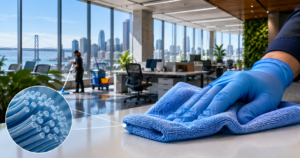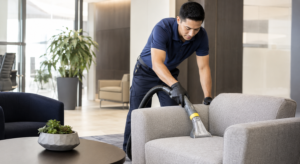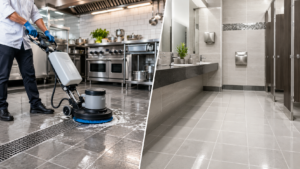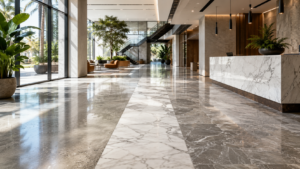
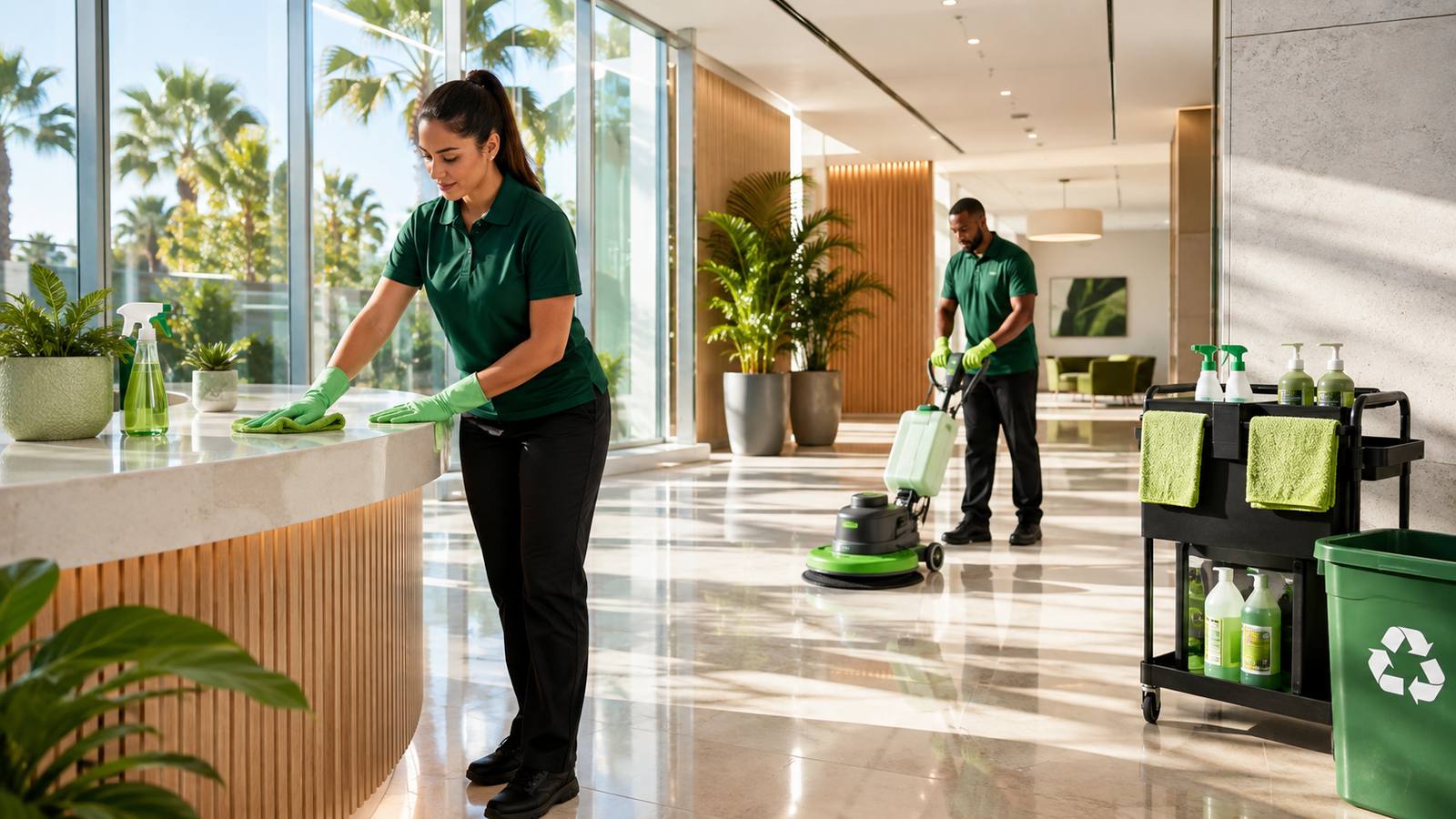
The phrase “green cleaning” appears on product labels, service proposals, and sustainability plans, but it does not always mean the same thing. Some people use it to describe a plant-based cleaner. Others assume it means avoiding all chemicals. For a California commercial facility, a useful green cleaning program should go much further.
At First Service Janitorial, we view green cleaning as a complete approach to maintaining a facility. It considers which products are used, how they are diluted, how much water is consumed, how waste is separated, how equipment is maintained, and how cleaning affects the people who use the building.
Our janitorial services throughout the Bay Area include eco-friendly options for businesses seeking safer, healthier, and more environmentally conscious workplaces. We tailor these options to the facility rather than forcing every property into the same program.
What Is the Quick Answer About Green Cleaning?
Green cleaning is a facility care system designed to reduce unnecessary environmental and human exposure while still achieving the required level of cleanliness.
A meaningful green cleaning program may include:
- Selecting products using credible environmental and safety criteria
- Using the correct product for each surface
- Following dilution and application instructions
- Preventing unnecessary chemical use
- Cleaning before disinfecting
- Disinfecting only where the facility requires it
- Using equipment and methods that control dust
- Reducing water and product waste
- Supporting recycling and organics collection
- Training cleaning personnel
- Measuring cleaning quality and correcting problems
Green cleaning does not mean leaving surfaces inadequately cleaned. It also does not mean that every product must be homemade, fragrance-free, chemical-free, or labeled “natural.” The goal is to make informed choices that balance cleanliness, occupant needs, surface protection, safety, performance, and environmental impact.
Does California Have One Universal Definition of Green Cleaning?
California does not impose one simple green cleaning definition on every private commercial facility. Requirements may vary based on the property type, products used, waste generated, local programs, contracts, and regulatory responsibilities.
The California Department of General Services has environmentally preferable purchasing standards for state procurement. These standards establish minimum criteria for goods and services to be considered environmentally preferable, or “green,” when purchased by California state agencies. They include standards for janitorial services, cleaners, and janitorial paper products. These standards can also provide a useful reference point for private facility managers, although state purchasing rules do not automatically apply to every private business.
For most commercial facilities, green cleaning should be treated as a documented operational program rather than a vague marketing phrase.
How Should California Facilities Choose Greener Cleaning Products?
Product selection is an important part of green cleaning, but it is not the entire program. Facility managers should consider product ingredients, intended use, performance, packaging, concentration, pH, volatile organic compounds, and directions for safe handling.
The United States Environmental Protection Agency operates a voluntary program that evaluates qualifying products based on chemical ingredients and other criteria. The agency also provides a separate environmental label for qualifying antimicrobial products, including certain sanitizers and disinfectants. These programs can help commercial purchasers identify products that have been evaluated against established criteria.
However, a label should not replace a facility-specific review. Before introducing a product, managers should ask:
- Is the product suitable for the intended surface?
- Is cleaning, sanitizing, or disinfecting actually required?
- What dilution ratio should be used?
- What personal protective equipment is required?
- Is ventilation recommended?
- How should unused product or packaging be handled?
- Is the product compatible with the facility’s equipment and finishes?
At First Service Janitorial, we match cleaning methods to the facility’s requirements. Our commercial care services include routine facility cleaning, floor and carpet care, restroom sanitation, window cleaning, waste handling, and flexible scheduling.
Why Does Proper Dilution Matter?
Using more product than the label requires does not necessarily make a surface cleaner. Overuse may leave residue, damage finishes, create stronger odors, waste money, and increase the amount of material entering the waste stream.
Using too little product can also be a problem because the solution may not perform as intended. This is especially important when a product has a required concentration or contact time.
A green cleaning plan should establish:
- Approved dilution ratios
- Clearly labeled secondary containers
- Controlled dispensing procedures
- Product-specific training
- Safety data sheet access
- Inventory and storage procedures
Accurate dilution helps the product perform correctly while controlling unnecessary consumption.
Do Volatile Organic Compounds Matter?
Some cleaning products can release volatile organic compounds, commonly called VOCs. These compounds may contribute to odors, indoor pollutant levels, or outdoor air-quality concerns, depending on the product and how it is used.
The California Air Resources Board regulates VOC emissions from numerous consumer product categories, including certain cleaning products. The applicable limit depends on how a product is classified under California regulations. A product should not be assumed compliant simply because it is advertised as environmentally friendly.
Facility managers should review labels, purchasing specifications, and manufacturer documentation instead of relying only on promotional descriptions.
How Does Green Cleaning Affect Indoor Air Quality?
Cleaning activities can affect the indoor environment. Products may release odors or chemical compounds, while dry dusting, sweeping, or poorly maintained equipment can return fine particles to the air.
The Environmental Protection Agency identifies cleaning products as one possible indoor source of chemical pollutants. It recommends considering indoor air quality when purchasing products and managing housekeeping activities. Ventilation, pollutant-source control, filtration, moisture control, and prompt waste removal all contribute to indoor air management.
We support indoor environmental goals by planning how and when cleaning occurs. Depending on the facility, useful practices may include:
- Scheduling stronger cleaning tasks during lower-occupancy hours
- Following product ventilation instructions
- Keeping supply and return vents unobstructed
- Using controlled dust-removal methods
- Removing trash before odors develop
- Addressing water spills promptly
- Avoiding unnecessary fragrances
- Keeping equipment clean and properly maintained
Our one-time commercial cleaning services can also support seasonal deep cleaning, move-ins, special events, and areas with accumulated dust or soil. The service includes surface cleaning, restroom care, interior glass cleaning, trash removal, breakroom cleaning, and flexible scheduling.
Does Green Cleaning Mean Avoiding Disinfectants?
No. Green cleaning does not require a facility to eliminate disinfectants. It means using them thoughtfully and correctly.
Routine cleaning removes soil and organic material from surfaces. Disinfection is a separate process intended to address specified microorganisms. Not every surface needs to be disinfected during every service visit. Using a disinfectant where ordinary cleaning would be sufficient may increase product consumption without providing a meaningful benefit.
When disinfection is required, the product should be appropriate for the target surface and intended purpose. The label may specify:
- Target organisms
- Dilution requirements
- Application methods
- Contact or dwell time
- Ventilation precautions
- Required protective equipment
- Surface compatibility
- Storage and disposal instructions
Our commercial disinfection services focus on high-touch surfaces and facility-specific needs. Facility managers can also review our guide to choosing registered disinfectants in California.
A green program should never reduce a required contact time, alter the dilution, or use a product for an unapproved purpose simply to save material.
How Should Cleaning Chemicals Be Managed Safely?
A product does not become risk-free because it has environmentally preferable characteristics. Cleaning personnel must still receive information about the chemicals they use.
The Occupational Safety and Health Administration requires employers with hazardous workplace chemicals to maintain labels and safety data sheets and provide appropriate worker training. Employees must be able to understand the hazards and protective measures associated with the products they handle.
A responsible green cleaning program should include:
- A current chemical inventory
- Readable product labels
- Accessible safety data sheets
- Approved storage locations
- Required gloves, eye protection, or other equipment
- Spill-response instructions
- Rules against unauthorized product mixing
- Training when a new chemical hazard is introduced
Switching products without updating training and documentation can create confusion. Product changes should be reviewed before cleaners begin using them.
How Can Green Cleaning Reduce Facility Waste?
Green cleaning also addresses the materials used and discarded during routine service. Product containers, paper products, liners, disposable wipes, food-soiled paper, and breakroom waste can make up a significant part of a commercial facility’s waste stream.
A practical plan may use concentrated products when appropriate, controlled dispensers, durable cleaning tools, reusable microfiber materials, properly sized waste liners, and purchasing systems that prevent excess inventory.
California businesses may also have responsibilities related to organic waste collection and recycling. State regulations require commercial businesses to provide or arrange for organic waste collection services consistent with applicable requirements. Businesses may need properly located containers with the correct colors and labels for employees, contractors, tenants, and customers. Local jurisdictions oversee many collection details, so facilities should confirm the rules that apply at their location.
Our role may include emptying designated containers, replacing liners, keeping collection areas clean, and reporting contamination. The facility remains responsible for determining its required waste streams and arranging compliant collection.
How Can Green Cleaning Protect Floors and Building Materials?
Replacing damaged flooring, carpet, fixtures, and furnishings consumes materials and creates waste. Proper maintenance can help facilities obtain more useful service from existing assets.
Green cleaning should therefore consider the life of the surface, not just the environmental profile of the product. Using the wrong chemical, brush, pad, temperature, or moisture level can damage carpet fibers, floor finishes, upholstery, stone, grout, and other materials.
Our approach includes selecting methods based on the surface and soil level. Facility managers can review our commercial carpet maintenance guide for information about routine vacuuming, spot treatment, and periodic extraction.
A strong maintenance program can include:
- Entrance mat care to reduce tracked-in soil
- Frequent removal of abrasive dirt
- Prompt spot treatment
- Correct floor pads and equipment
- Periodic deep cleaning based on actual conditions
- Product testing in an inconspicuous area
- Inspection for moisture or recurring damage
This approach connects sustainability with preventive care.
How Can Facility Managers Measure Green Cleaning Results?
A green cleaning program should be measurable. Buying different products is not enough if floors remain dirty, dispensers are misused, waste streams are contaminated, or workers do not follow the procedures.
We recommend reviewing:
- Cleaning inspection results
- Product usage and dilution
- Supply consumption
- Waste-sorting problems
- Occupant complaints
- Odor concerns
- Floor and carpet condition
- Equipment maintenance
- Training completion
- Corrective-action records
Our guide to a California janitorial inspection checklist provides a useful starting point for documenting cleaning quality.
At First Service Janitorial, we customize our services around each client’s facility type, schedule, priorities, and expectations. We serve a range of commercial properties, including offices, schools, medical facilities, gyms, event venues, hospitality properties, retail spaces, and manufacturing facilities.
Which Organizations Support These Green Cleaning Guidelines?
Works Cited
California Air Resources Board. “Consumer Products Program.” State of California, accessed 6 Aug. 2026.
California Department of General Services. “Environmentally Preferable Purchasing.” State of California, accessed 6 Aug. 2026.
California Department of General Services. “Purchasing Standards.” State of California, accessed 6 Aug. 2026.
California Department of Resources Recycling and Recovery. “Collection Systems, Container Colors, and Labeling.” State of California, accessed 6 Aug. 2026.
Occupational Safety and Health Administration. “Hazard Communication.” United States Department of Labor, accessed 6 Aug. 2026.
United States Environmental Protection Agency. “Identifying Greener Cleaning Products.” EPA, accessed 6 Aug. 2026.
United States Environmental Protection Agency. “An Office Building Occupant’s Guide to Indoor Air Quality.” EPA, accessed 6 Aug. 2026.
United States Environmental Protection Agency. “Learn About the Safer Choice Label.” EPA, accessed 6 Aug. 2026.