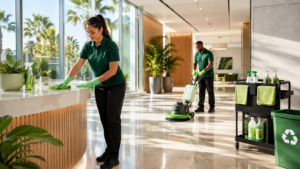
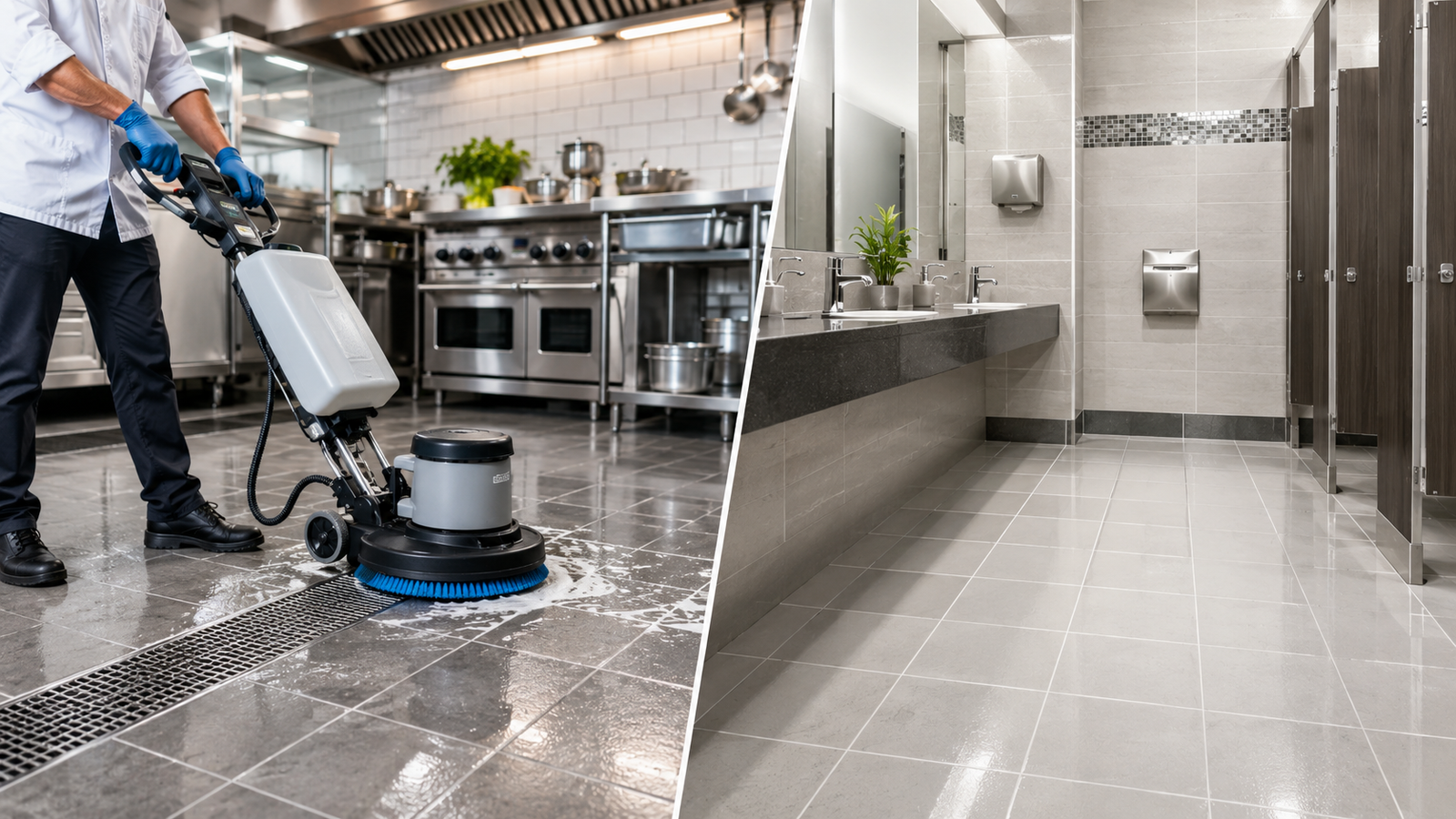
Tile is practical for busy commercial kitchens and restrooms, but soil can settle along edges, around fixtures, and inside grout joints. Grease, moisture, soap residue, tracked-in dirt, and heavy traffic all affect the floor.
Regular tile and grout cleaning supports a professional appearance, controls buildup, and helps staff identify cracked tile, missing grout, or drainage problems. The right plan combines spill response, daily soil removal, detail cleaning, safe product selection, and condition-based inspections.
Why Do Commercial Kitchens and Restrooms Need Targeted Floor Care?
Commercial kitchens and restrooms are both high-demand areas, but they collect different kinds of soil.
In a kitchen, the floor may receive food particles, grease, beverage spills, moisture, and soil carried in from receiving or dining areas. In a restroom, common concerns include soap residue, water spots, mineral deposits, tracked-in soil, and buildup near toilets, urinals, sinks, partitions, and drains.
A general routine may improve the open floor while leaving edges and grout lines behind. A targeted program reaches those areas and connects floor care with commercial cleaning services, kitchen cleaning, and restroom sanitation.
Why Can Grout Look Dirty Before the Tile Does?
Glazed tile usually has a smoother, less absorbent surface than many cement-based grout joints. As a result, soil may be easier to see and harder to remove from the grout. Not every grout is the same, however. Epoxy grout, cement-based grout, and previously treated grout can respond differently to moisture, cleaning products, and agitation.
Grout can darken because of:
- Soil held in the grout’s texture
- Greasy residue in kitchen traffic lanes
- Dirty cleaning solution left in joints
- Soap, mineral, or organic buildup in restrooms
- Moisture that has not fully dried
- Wear, staining, or deterioration that cleaning may not reverse
Before deep cleaning, identify the tile and grout type when possible. Test the process in an inconspicuous area to reduce the risk of discoloration or damage.
What Buildup Is Common on Commercial Kitchen Tile and Grout?
Kitchen floors need dry debris removal before wet cleaning. Otherwise, mopping can spread food and soil into corners and joints. Place warning signs, use a compatible solution at the labeled dilution, agitate soiled areas, recover dirty solution, rinse when directed, and let the floor dry before reopening it.
Floors and grout are generally not food-contact surfaces, so their procedure should not be confused with requirements for food-contact counters, tools, or equipment. A broader cafeteria cleaning guide can help coordinate floor work with the full food-service plan.
Which Kitchen Areas Deserve Extra Attention?
The most visible walkway is not always the most heavily soiled location. Inspections should also cover:
- Floor-wall transitions
- Areas near sinks, dishwashing stations, and drains
- Traffic lanes between preparation and service areas
- Accessible spaces beside or beneath movable equipment
- Entry points from loading, storage, or dining spaces
- Corners where mops and floor machines may not reach
Persistent moisture may indicate a leak or drainage problem. Cleaning removes soil, but it cannot repair plumbing or replace missing grout.
What Buildup Is Common on Restroom Tile and Grout?
Restroom floors often look acceptable in the center while soil remains around fixtures and along edges. Routine checks should address the entire room, including corners, partition bases, sink areas, and the floor near toilets or urinals.
A good program connects floor cleaning with fixture care, touchpoint care, trash removal, and supply checks. The site’s restroom sanitation guidance treats the room as a complete service area. Odor should be traced to residue, fixture bases, drains, leaks, or another source instead of being covered with fragrance.
Why Do Edges, Corners, and Fixture Bases Matter?
These locations receive less contact from standard mops and may stay damp longer. Use detail tools without flooding the floor. Record cracked, loose, or missing grout for repair because aggressive scrubbing cannot restore a damaged joint.
How Are Cleaning, Sanitizing, and Disinfecting Different?
Cleaning removes soil. Sanitizing reduces certain microorganisms to levels defined by a label or applicable requirement. Disinfecting uses a registered product to kill listed microorganisms when used exactly as directed.
Visible soil can interfere with a disinfectant, so cleaning normally comes first. When disinfection is appropriate, the product must be compatible with the surface and left wet for the full label contact time.
Routine tile and grout cleaning does not automatically disinfect a floor. A separate commercial disinfection service may be incorporated when the facility’s needs and the product label support it.
How Can Cross-Contamination Be Reduced?
Kitchen and restroom tools should be kept separate. A mop, brush, bucket, cloth, or solution used in a restroom should not be carried into a food-service area.
Assign and store tools by area, clean lower-soil zones first, change dirty solution, and wash and dry reusable tools. The written scope should make these boundaries clear. Professional janitorial services can combine area-specific procedures with after-hours or weekend scheduling.
What Tile and Grout Cleaning Schedule Works Best?
There is no universal schedule. Frequency should reflect traffic, operating hours, soil load, weather, floor texture, inspection results, and local requirements.
What Should Happen During Operating Hours?
During use, focus on immediate risk control:
- Respond to spills promptly.
- Remove visible debris.
- Place signs or barriers around wet areas.
- Check high-use restrooms at planned intervals.
- Record leaks or damaged flooring.
What Should Happen Each Day?
Daily or after-use service may include dry soil removal, compatible damp cleaning, edge and drain checks, and removal of visible residue. Dirty water can redeposit soil in grout, so clean solution and maintained tools matter.
When Is Periodic Deep Cleaning Needed?
Darkened grout, greasy lanes, recurring odor, fixture buildup, or uneven results can trigger detail work. The interval may be weekly, monthly, quarterly, or condition-based. A janitorial inspection checklist helps document results. One-time cleaning services may support seasonal work or recovery from deferred maintenance.
How Can Improper Cleaning and Wet Floors Create Problems?
Too much chemical or water can leave residue, discolor grout, dull tile, or create slippery conditions. Never mix chemicals or ignore dilution, dwell time, and ventilation instructions. Avoid flooding damaged grout, use signs or barriers, and keep the room closed until the floor is dry.
Recurring wet areas may require plumbing repair, drainage correction, mat placement, or faster spill response. For continuous operations, a day porter may manage checks and spills while detail cleaning occurs after hours. This comparison of day porter and nightly janitorial services can help divide responsibilities.
What Should a Tile and Grout Inspection Include?
Instead of marking a floor simply “clean” or “dirty,” review:
- Open floor areas and traffic lanes
- Grout color consistency
- Corners, edges, and fixture bases
- Grease or residue after drying
- Odor sources
- Standing water or slow drainage
- Cracked tile, loose tile, and missing grout
- Tool condition and wet-floor controls
Photos and notes help track repeat problems. Managers can also audit a janitorial provider to confirm that the written scope matches actual conditions.
How Can First Service Janitorial Support Regular Tile and Grout Care?
First Service Janitorial lists floor care, kitchen cleaning, restroom sanitation, surface disinfection, routine facility cleaning, and flexible scheduling within its commercial scope. A proposal should identify the rooms, frequency, operating constraints, floor condition, detail areas, and inspection expectations. It should also separate cleaning from repairs or specialty work.
Bay Area facility managers can request a custom cleaning quote based on the building’s traffic, tile type, grout condition, kitchen use, restroom demand, and preferred schedule.
Which Organizations Support These Recommendations?
Which Works Were Cited?
Centers for Disease Control and Prevention. “When and How to Clean and Disinfect a Facility.” Water, Sanitation, and Environmentally Related Hygiene, https://www.cdc.gov/hygiene/about/when-and-how-to-clean-and-disinfect-a-facility.html. Accessed 24 July 2026.
Occupational Safety and Health Administration. “1910.141: Sanitation.” United States Department of Labor, https://www.osha.gov/laws-regs/regulations/standardnumber/1910/1910.141. Accessed 24 July 2026.
Tile Council of North America. “A Few Tips on Keeping Bathroom Tile and Grout Clean.” Tile Council of North America, https://tcnatile.com/wp-content/uploads/2022/08/Bathroom-Tile-and-Grout-A-Few-Tips-on-Keeping-Them-Clean.pdf. Accessed 24 July 2026.
United States Environmental Protection Agency. “Selected EPA-Registered Disinfectants.” United States Environmental Protection Agency, https://www.epa.gov/pesticide-registration/selected-epa-registered-disinfectants. Accessed 24 July 2026.
United States Food and Drug Administration. Food Code 2022. United States Department of Health and Human Services, 18 Jan. 2023, https://www.fda.gov/media/164194/download. Accessed 24 July 2026.