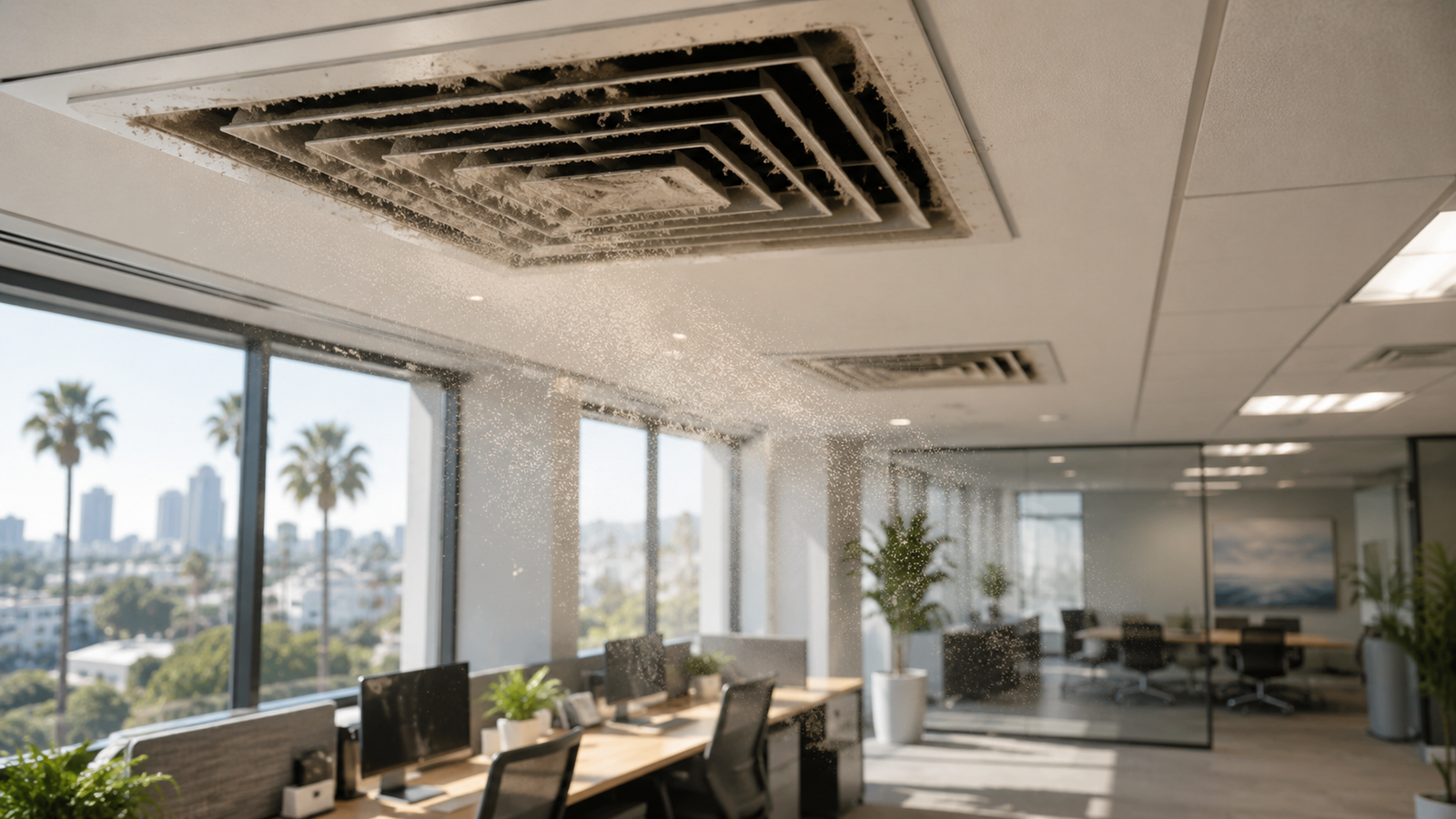
Indoor air quality is easy to overlook when an office looks clean at first glance. Desks may be wiped, trash may be removed, and floors may look presentable, but dust can still collect on high surfaces, fixtures, carpet fibers, and around HVAC supply and return vents.
At First Service Janitorial, we look at office cleanliness as a complete facility issue. A clean workplace is not only about the areas people touch every day. It also means paying attention to the surfaces where dust gradually settles and can be disturbed again through normal activity and airflow.
For California facility managers, this makes HVAC vents and dust accumulation worth watching. Dust on a vent grille does not automatically mean there is a problem inside the HVAC system, but it can show that dust is accumulating in an area that needs cleaning attention.
Our role is focused on the janitorial side of the issue. Through our office building cleaning services, we help keep offices cleaner through dusting, vacuuming, floor care, common-area cleaning, trash removal, and other regularly scheduled cleaning tasks. We do not diagnose HVAC equipment or perform internal air-duct cleaning.
Why does dust accumulate around HVAC vents in office buildings?
Dust is a normal part of almost every commercial environment. It can enter a building from outdoors, travel in on clothing and shoes, come from paper and furnishings, or be created during renovation and maintenance activities.
Once inside, some particles settle on surfaces while smaller particles may remain suspended in the air for a period of time. Air movement can also redistribute settled particles.
HVAC vents often become noticeable collection points because air is constantly moving around them. Supply registers push conditioned air into a room, while return grilles draw room air back toward the ventilation system.
The result is that fine dust may become visible on:
- Vent grilles and surrounding ceiling surfaces
- Desks, shelves, cabinets, and fixtures
- Window ledges and partitions
- Carpet and flooring near heavily traveled areas
- Corners and other surfaces that receive less frequent cleaning
- High surfaces that are outside the normal daily cleaning zone
Visible accumulation should be treated as a housekeeping signal. It tells us that the cleaning schedule, scope, or frequency may need to be reviewed.
How can accumulated dust affect indoor air quality?
Indoor air quality depends on several factors, including sources of indoor pollutants, ventilation, filtration, moisture conditions, building maintenance, and cleaning practices.
Dust is only one part of that picture.
When dust collects on office surfaces, normal activities can disturb it. Walking across carpet, moving furniture, opening doors, cleaning improperly, or creating strong air movement can allow some settled particles to become airborne again.
That is one reason routine cleaning matters. Source control starts with removing dust from the building instead of allowing it to build up indefinitely.
Our commercial cleaning services are designed around the way each facility is actually used. Recurring janitorial cleaning addresses the everyday buildup that occurs in offices, while periodic commercial care can provide deeper attention to carpets, flooring, upholstery, and other surfaces that require more than routine maintenance.
Cleaning alone cannot control every aspect of indoor air quality. Ventilation and filtration remain building-system responsibilities. However, keeping office surfaces and floors clean helps address one important source of indoor particulate buildup.
Does dust on an HVAC vent mean the air ducts are dirty?
Not necessarily.
Visible dust on a supply or return grille should not automatically be interpreted as evidence that the interior ductwork is contaminated.
A grille is exposed directly to the occupied office environment. Dust can settle on it just as it settles on lighting fixtures, shelves, window sills, and other surfaces.
That distinction is important because janitorial cleaning and HVAC maintenance are separate responsibilities.
At First Service Janitorial, we concentrate on accessible surfaces that fall within the agreed cleaning scope. If a facility manager suspects an internal mechanical, ventilation, filtration, or duct problem, that portion of the investigation should be handled by qualified building maintenance or HVAC personnel.
What should facility managers look for around vents?
Facility managers can pay attention to patterns rather than drawing conclusions from a single dusty register.
For example, if several accessible vents become visibly dusty soon after routine cleaning, it may be worth reviewing both the cleaning schedule and the building’s HVAC maintenance practices. If the problem is limited to a particular area, consider what happens in that space, including foot traffic, renovation work, paper handling, nearby entrances, and the frequency of cleaning.
The goal should be to identify where the dust is coming from and address the appropriate part of the problem.
Why does routine office cleaning matter for dust control?
Dust control works best when it is consistent.
Waiting until surfaces are visibly coated allows more material to accumulate throughout the workplace. A recurring program removes dust before that buildup becomes part of the everyday condition of the office.
Our office janitorial programs can be structured around the facility’s size, traffic, schedule, and priorities. Typical office cleaning can include dusting desks, surfaces, and fixtures along with vacuuming, mopping, trash collection, restroom cleaning, break room cleaning, and common-area care.
This approach is particularly useful in corporate offices, multi-tenant buildings, coworking spaces, and executive suites where many people share the same environment.
Dust control should also extend beyond obvious horizontal surfaces. During a facility walkthrough, areas that repeatedly collect dust can be identified and incorporated into an appropriate cleaning rotation.
How do carpets contribute to office dust accumulation?
Carpet requires particular attention because routine foot traffic continually brings soil and particles into a building.
Regular vacuuming helps remove surface debris before it works deeper into carpet fibers. Over time, however, routine vacuuming is not the only maintenance a commercial carpet may need.
That is where our commercial care services can support the overall facility cleaning program. Our current service scope includes carpet cleaning and hot-water extraction as periodic deep-cleaning services.
This distinction matters. Routine janitorial cleaning maintains a surface between deeper services. Periodic commercial care addresses material that routine maintenance may no longer remove effectively.
Keeping carpets maintained also improves the overall appearance of the office and reduces the amount of accumulated soil left in one of the building’s largest surfaces.
When can a one-time deep clean help with heavy dust buildup?
There are situations where normal recurring cleaning is not enough to reset a facility.
Construction and renovation are good examples. These activities can create unusually high levels of fine dust that settle on fixtures, ledges, flooring, and other surfaces.
Our one-time commercial cleaning service specifically includes post-construction and post-renovation cleanup among the situations we handle. For post-construction cleaning, our current scope can include removing construction dust from surfaces such as fixtures, vents, sills, and hard-to-reach areas, followed by detailed cleaning of floors, glass, and restrooms.
The exact scope is confirmed during the facility walkthrough.
A one-time clean can also make sense for:
seasonal facility resets, move-in or move-out situations, preparation for property inspections, and the first deep cleaning before a recurring janitorial program begins.
The important point is that unusual dust conditions may require a more detailed cleaning scope than an ordinary nightly visit.
Can blocked or dirty vent areas become a facility concern?
Ventilation systems need unobstructed airflow to operate as intended. Furniture, boxes, stored materials, and other objects should not be allowed to block supply or return vents.
Cleaning teams can support good facility conditions by keeping accessible areas around vents clean and by reporting noticeable conditions to facility management when appropriate.
However, the mechanical performance of the HVAC system remains separate from janitorial work.
If occupants are reporting persistent comfort or indoor air concerns, or if airflow appears unusually weak, building management should evaluate the ventilation system rather than treating surface cleaning as the complete solution.
This creates a more responsible division of work. We address cleanliness within our scope, while the appropriate building professionals handle mechanical ventilation, filters, controls, and internal HVAC components.
How can California office managers build dust control into a cleaning program?
There is no single cleaning frequency that works for every office.
A small professional office with limited traffic will have different needs from a large multi-tenant building with busy entrances, shared kitchens, conference rooms, and common corridors.
Our approach is to look at how the building is actually used.
Through our broader industry-specific commercial cleaning programs, the cleaning scope can be adjusted according to facility type rather than applying the same checklist everywhere.
For office buildings, that means looking at traffic patterns, flooring types, shared spaces, operating hours, problem areas, and the level of daytime or after-hours attention required.
Facilities with unusually heavy dust may benefit from reviewing both recurring tasks and periodic deep-clean requirements instead of simply increasing one type of cleaning.
Why should dusting, vacuuming, and floor care work together?
Dust does not remain in one place.
Material that settles on a desk today can eventually reach the floor. Soil on flooring can be disturbed by foot traffic. Dust on a fixture can become airborne when the area is disturbed.
That is why focusing only on a single surface leaves gaps.
A complete janitorial program coordinates several basic tasks so dust and soil are removed from different areas of the facility on an appropriate schedule.
Vacuuming addresses carpeted areas. Mopping and floor care address hard surfaces. Dusting removes buildup from desks, fixtures, ledges, and other accessible areas. Periodic commercial care provides deeper attention when routine cleaning is no longer enough.
Together, these services create a more consistent standard throughout the office.
Should disinfection be used to solve a dust problem?
No. Cleaning and disinfection serve different purposes.
Dust is primarily a cleaning issue. It needs to be physically removed from the surface.
Our disinfection services are intended for targeted treatment of high-touch surfaces and shared spaces after appropriate cleaning. Disinfection should not be treated as a replacement for removing visible soil and dust.
For most office environments, a sensible program begins with routine cleaning. Additional disinfection can then be concentrated where the facility’s hygiene needs justify it.
Understanding the difference prevents unnecessary chemical use and helps ensure each task has a clear purpose.
How can facility managers tell when their cleaning scope needs adjustment?
A cleaning program should change when the condition or use of the building changes.
If you are repeatedly seeing dust on vent grilles, ledges, fixtures, carpet edges, or other areas soon after service, it may indicate that those surfaces are not included often enough in the current rotation.
Similarly, a renovation, tenant move, increase in building occupancy, or change in office layout may create new cleaning needs.
Instead of assuming the existing scope will continue to work indefinitely, facility managers should periodically walk the building and compare actual conditions with the contracted cleaning tasks.
Our Bay Area service coverage includes offices and commercial facilities across San Jose, Santa Clara County, and the wider service area listed on our site. We build cleaning programs around the individual facility rather than assuming every office requires the same frequency.
How can First Service Janitorial help keep California offices cleaner?
At First Service Janitorial, our role is straightforward: we help commercial facilities maintain cleaner, well-presented spaces through recurring janitorial service, commercial care, targeted disinfection, and one-time deep cleaning.
For an office concerned about HVAC vent dust, our first step is not to make claims about what is happening inside the mechanical system. Instead, we look at the areas we can properly address.
That can include checking the condition of accessible surfaces, floors, carpets, fixtures, and other areas where dust is accumulating. From there, we can help determine whether the existing cleaning schedule and scope are keeping pace with the building.
If internal HVAC concerns remain, facility management can address those separately with the appropriate mechanical professionals.
This approach keeps responsibilities clear while still addressing an important part of indoor environmental quality: preventing unnecessary dust and soil from accumulating throughout the occupied workspace.
Facility managers who want to review their current cleaning program can request a cleaning quote and facility evaluation so we can look at the building, understand the problem areas, and recommend a cleaning scope based on the actual facility.
Which organizations support these indoor air quality recommendations?
Works Cited
California Department of Public Health. “Ventilation.” California Department of Public Health. Accessed 20 Aug. 2026. California ventilation guidance
Occupational Safety and Health Administration. “Indoor Air Quality: Building Operations and Management.” Occupational Safety and Health Administration. Accessed 20 Aug. 2026. Workplace indoor air quality guidance
United States Environmental Protection Agency. “An Office Building Occupant’s Guide to Indoor Air Quality.” United States Environmental Protection Agency. Accessed 20 Aug. 2026. Office building indoor air quality guidance
United States Environmental Protection Agency. “Factsheet: What Is Indoor Air Quality?” United States Environmental Protection Agency, updated 23 June 2026. Accessed 20 Aug. 2026. Indoor air quality factsheet