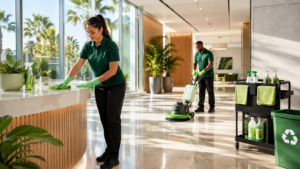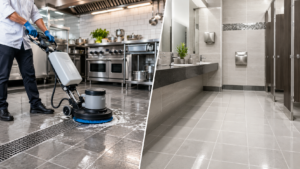
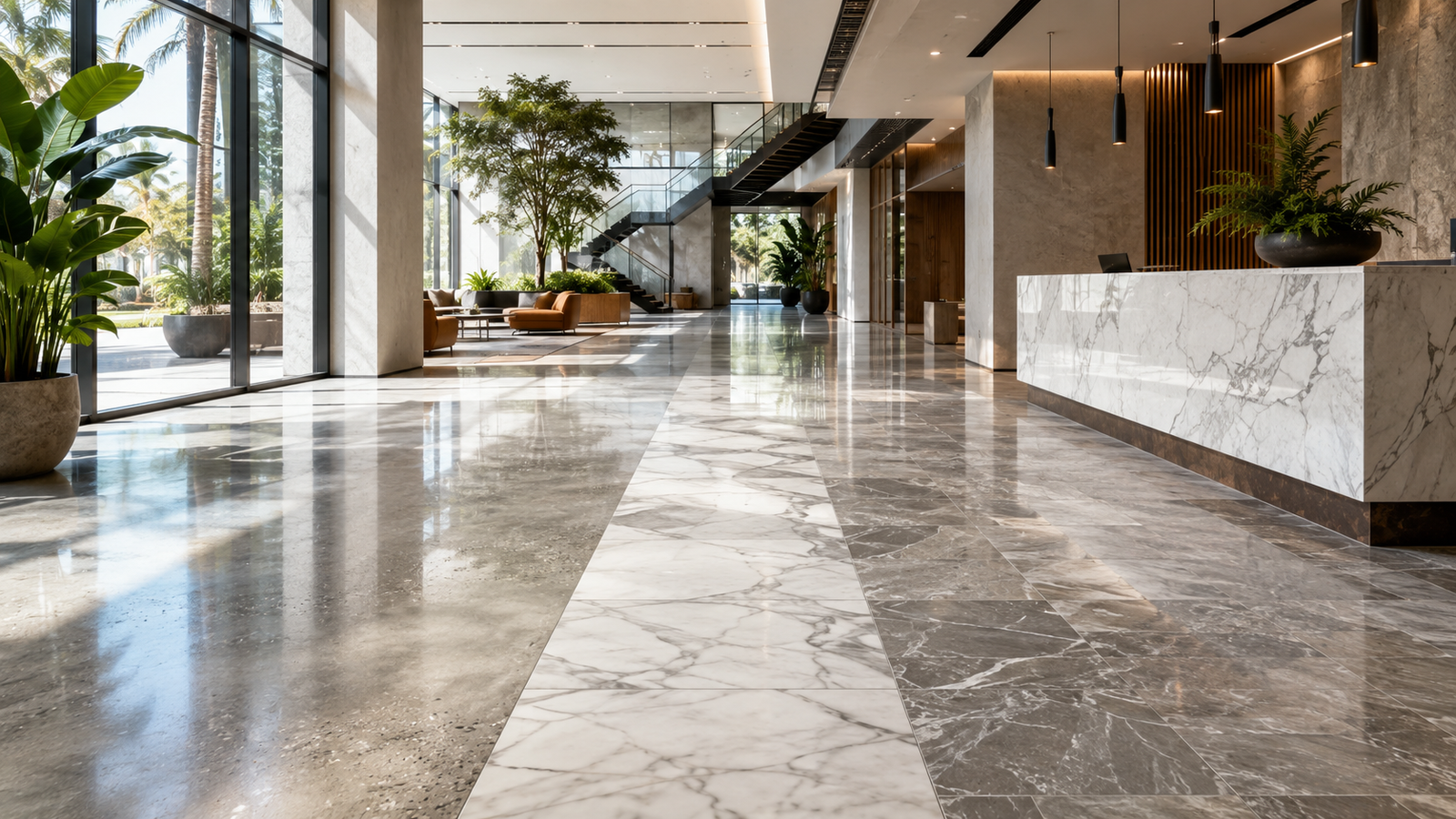
Concrete, marble, and stone can create durable, professional-looking commercial floors. However, they do not respond to cleaning products, moisture, equipment, or wear in the same way. Effective care starts with identifying the surface, then combining dry-soil removal, spill response, compatible products, detail work, and inspections.
Why Must Facility Managers Identify the Floor Before Cleaning It?
A floor should not be treated simply as “hard surface.” Determine whether it is polished or coated concrete, marble, granite, limestone, travertine, slate, or another material. Also identify any finish, sealer, grout, or previous repair.
This information affects:
- Which cleaner can be used safely
- Whether the floor tolerates water and agitation
- Which pads, brushes, or machines are appropriate
- How spills and stains should be handled
- Whether a dull area is soil, wear, etching, or coating damage
If records are unavailable, test the method in an inconspicuous area. A commercial floor care plan should document known materials and restrictions.
How Should Commercial Concrete Floors Be Maintained?
Concrete may be bare, polished, dyed, sealed, or coated. An aggressive cleaner or pad can affect a coating or change polished concrete’s appearance. Remove grit first, damp clean with a compatible product, and recover dirty solution before it dries.
Facility teams should watch for:
- Dust or grit near entrances
- Tire marks or equipment traffic in service areas
- Greasy residue in breakrooms or production spaces
- Coating wear in repeated traffic lanes
- Cracks, spalling, or loose repairs
- Moisture coming through or collecting on the floor
Cleaning cannot repair structural cracks, correct moisture movement, or replace a failed coating. Record these conditions for evaluation.
Why Does Marble Require More Cautious Care?
Marble contains calcium carbonate and can react with acidic substances. Vinegar, citrus-based solutions, acidic restroom products, and some descalers may etch it. Etching changes the finish and often appears dull or light. It is not ordinary soil.
Routine marble care should focus on:
- Frequent removal of abrasive sand and grit
- Prompt blotting of spills
- A compatible neutral cleaner
- Clean water and clean tools
- Soft pads or mops suitable for the finish
- Thorough drying before traffic resumes
Too much cleaner can leave film, while abrasive pads or damaged attachments may scratch the floor. If a mark remains, determine whether it is staining, etching, scratching, or wear before cleaning again.
How Can Other Natural Stone Floors Differ?
Granite, limestone, travertine, slate, and other stones differ in composition, texture, porosity, and finish. Do not assume that a general hard-floor product is safe. Confirm compatibility with the stone and any sealer. Avoid acids on acid-sensitive stone and abrasives on polished surfaces.
Sealing, honing, polishing, grinding, and restoration are not the same as routine cleaning. Before adding any of these activities to a service scope, the facility manager should confirm the floor’s needs and whether specialized work is included.
What Daily Hard Floor Care Routine Works Best?
Daily service should stop abrasive soil from moving through the building. Entrances often need the most attention because grit can scratch stone or wear coated and polished floors.
A useful routine includes:
- Inspect entrances, walkways, elevators, lobbies, and spill-prone areas.
- Remove loose soil with clean equipment that will not scratch the surface.
- Respond to spills using the procedure approved for that floor.
- Damp clean visible soil with a compatible product and correct dilution.
- Change dirty solution and rinse when directed.
- Use signs or barriers until the floor is dry.
- Record damage or recurring moisture.
This guide to cleaning open office floor plans can help managers plan around traffic instead of relying only on square footage.
When Should Periodic or Deep Floor Cleaning Be Scheduled?
Periodic work should follow inspection results, not a fixed calendar alone. Lobbies, retail aisles, elevator landings, and public corridors may need attention sooner than low-use rooms.
Possible triggers include:
- Soil that remains after routine cleaning
- Dark or dull traffic lanes
- Film, streaks, or residue after drying
- Buildup along edges and corners
- Recurring spots in food or beverage areas
- Uneven appearance between open areas and protected areas
The interval may be weekly, monthly, quarterly, seasonal, or condition-based. Reviewing seasonal cleaning challenges can help managers adjust entrance care and deep-cleaning frequency.
For events, move-ins, or delayed maintenance, one-time commercial cleaning may be added without assuming that restoration is included.
What Cleaning Mistakes Can Damage Concrete, Marble, or Stone?
Facility teams should avoid:
- Using acidic cleaners on marble or other acid-sensitive stone
- Mixing cleaners or disinfectants
- Using excessive chemical concentration
- Scrubbing with pads that are too aggressive
- Allowing dirty solution to dry on the floor
- Flooding cracks, damaged joints, or low areas
- Reopening an area before it is dry
Product labels, floor documentation, and manufacturer instructions should guide the process. When uncertain, test first and use the least aggressive effective method.
How Should Spills, Stains, Etching, and Wear Be Evaluated?
- Loose soil generally lifts with appropriate routine cleaning.
- Residue may feel sticky or leave streaks and can result from excess product or dirty solution.
- Staining changes the color below or within the surface.
- Etching changes the finish after an acid reacts with acid-sensitive stone.
- Scratching creates physical lines or abrasion.
- Wear develops gradually in repeated traffic paths.
- Coating failure may appear as peeling, flaking, or cloudiness.
Cleaning may remove soil and residue, but it does not necessarily reverse stains, etching, scratches, or wear. Photos can help determine whether routine care or separate corrective work is needed.
How Can California Facilities Reduce Wet-Floor Risks?
Plan floor care around traffic. California workplace rules require permanent floors to be in good repair and reasonably free of oil, grease, or water. Controls may include:
- Prompt spill response
- Visible warning signs and barriers
- Entrance mats with slip-resistant backing
- Drainage or moisture correction
- Cleaning during lower-traffic periods
- A final inspection before reopening
For buildings operating all day, a porter may handle spills while detail work occurs later. This comparison of day porter and nightly janitorial services can help assign responsibilities.
When Is Disinfection Appropriate for Hard Floors?
Cleaning removes soil and many germs. Disinfection uses a registered product to kill listed microorganisms when label directions are followed. If disinfection is required by policy, a contamination event, or industry-specific rules, confirm that the product is permitted on the floor material.
Clean visible soil first when directed, observe contact time, provide required ventilation and protective equipment, and never mix chemicals. A commercial disinfection plan should separate normal care from event-specific disinfection.
What Should a Hard Floor Inspection Include?
A useful inspection reviews more than shine. A glossy floor may hold residue, while wear can make a clean floor look dull.
Check:
- Entrances and main traffic lanes
- Corners, edges, and areas under movable furnishings
- Texture, color, and finish consistency
- Sticky residue or streaks after drying
- Scratches, etching, cracks, and coating damage
- Standing water or recurring moisture
- Condition of mats and cleaning tools
- Signs, barriers, and reopening procedures
The site’s janitorial inspection checklist provides a framework for documenting findings. Managers should also audit results to confirm that approved methods appear in the written scope and daily work.
How Can First Service Janitorial Support Commercial Hard Floor Care?
First Service Janitorial identifies hard floor care, tile and grout cleaning, routine facility cleaning, and flexible scheduling within its commercial services. Its janitorial cleaning programs support offices, schools, healthcare facilities, government buildings, and commercial spaces.
A proposal should identify the surface, condition, included rooms, frequency, periodic tasks, access limits, and inspection expectations. It should state whether polishing, sealing, repairs, or restoration are included.
Facility managers can review the commercial industries served and request a custom cleaning quote based on traffic, flooring materials, operating hours, and priorities.
Which Organizations Support These Recommendations?
Which Works Were Cited?
California Department of Industrial Relations. “California Code of Regulations, Title 8, Section 3273: Working Area.” Division of Occupational Safety and Health, https://www.dir.ca.gov/Title8/3273.html. Accessed 27 July 2026.
Centers for Disease Control and Prevention. “When and How to Clean and Disinfect a Facility.” Water, Sanitation, and Environmentally Related Hygiene, 16 Apr. 2024, https://www.cdc.gov/hygiene/about/when-and-how-to-clean-and-disinfect-a-facility.html. Accessed 27 July 2026.
Natural Stone Institute. “Care and Cleaning of Natural Stone.” Natural Stone Institute, https://www.naturalstoneinstitute.org/consumers/care/. Accessed 27 July 2026.
United States Environmental Protection Agency. “Selected EPA-Registered Disinfectants.” United States Environmental Protection Agency, 11 Sept. 2025, https://www.epa.gov/pesticide-registration/selected-epa-registered-disinfectants. Accessed 27 July 2026.