Commercial carpet deals with much more traffic than residential flooring. Employees, customers, students, patients, deliveries, rolling equipment, and outdoor soil can affect the carpet every day. Without a structured maintenance plan, soil becomes embedded, spills turn into permanent stains, and high-traffic lanes begin to look worn long before the rest of the carpet.
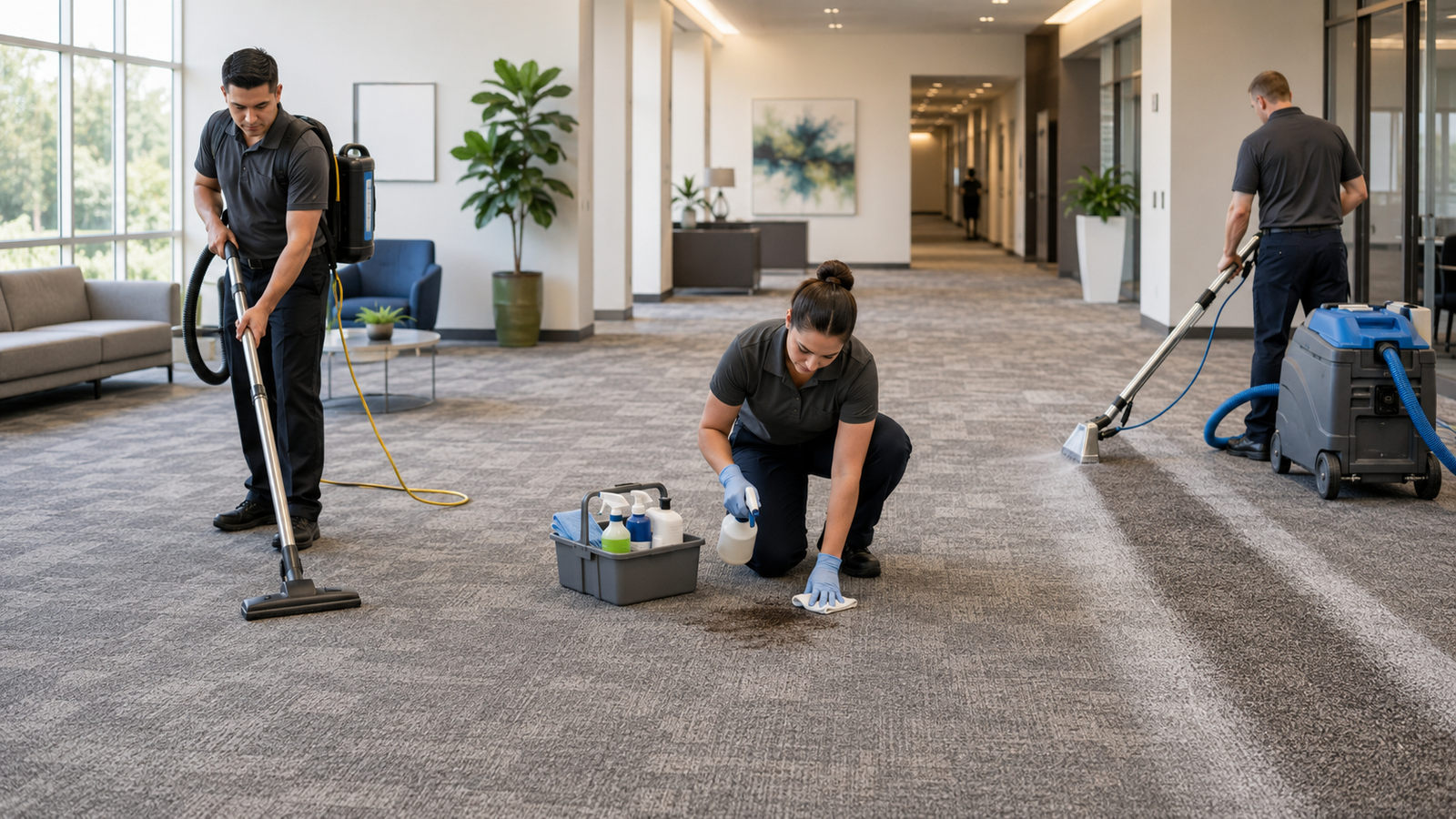
Effective commercial carpet maintenance is built around three levels of care: routine vacuuming, prompt spot treatment, and scheduled restorative cleaning when appropriate. Each level addresses a different type of soil.
First Service Janitorial includes carpet care within its commercial care services for Bay Area facilities. The right program should be based on carpet construction, traffic, building use, flooring instructions, and observed conditions rather than a single cleaning schedule applied to every room.
Why Does Commercial Carpet Need a Planned Maintenance Program?
Carpet can hold dry soil below the visible surface. By the time a traffic lane looks dirty, particles may already be embedded among the fibers. Repeated foot traffic can grind those particles against the carpet, contributing to a dull or uneven appearance.
A maintenance plan helps address soil before it becomes difficult to remove. It can also help facility managers:
- Maintain a more consistent appearance
- Respond to spills before they set
- Identify recurring problem areas
- Reduce visible traffic-lane differences
- Plan cleaning around business operations
- Avoid unnecessary restorative cleaning
- Document carpet condition over time
- Coordinate carpet care with other janitorial tasks
A planned approach is more effective than waiting until the entire carpet looks dirty. First Service Janitorial’s janitorial services can be customized around the needs of offices, schools, medical facilities, government buildings, and other commercial properties.
How Do Vacuuming, Spot Treatment, and Extraction Work Together?
Commercial carpet maintenance can be viewed as a layered process.
| Maintenance level | Primary purpose |
| Vacuuming | Removes loose, dry soil before it becomes embedded |
| Spot treatment | Addresses localized spills, marks, and stains |
| Interim cleaning | Refreshes appearance between restorative services |
| Hot-water extraction | Removes soil and cleaning residue from deeper within compatible carpet |
| Inspection | Identifies wear, recurring stains, moisture, and missed areas |
Vacuuming cannot remove every spill. Spot treatment cannot clean an entire traffic lane. Hot-water extraction should not replace routine dry-soil removal. The three methods support one another when used as part of the same maintenance program.
How Should Commercial Carpet Be Vacuumed?
Vacuuming is the foundation of commercial carpet maintenance. Dry soil is generally easier to remove before it becomes wet, sticky, or deeply embedded.
The most important areas are not always the largest rooms. Entrances, reception areas, elevator lobbies, hallways, breakrooms, copy areas, and paths between workstations may collect soil faster than low-traffic offices.
Which Carpet Areas Need the Most Frequent Vacuuming?
Facility managers should divide the carpet into traffic zones:
- High-traffic zones: Main entrances, lobbies, hallways, reception areas, and shared spaces
- Medium-traffic zones: Conference rooms, open offices, libraries, and administrative areas
- Low-traffic zones: Private offices, storage rooms, and rarely used meeting spaces
- Detail zones: Edges, corners, under furniture, around doors, and near baseboards
High-traffic zones may need attention more frequently than the rest of the building. The schedule should change when occupancy, events, construction, or weather conditions increase soil levels.
What Vacuuming Practices Improve Results?
Effective commercial vacuuming generally includes:
- Removing larger debris before vacuuming
- Using equipment appropriate for the carpet type
- Moving at a controlled pace
- Making additional passes over visible traffic lanes
- Cleaning edges and corners with suitable attachments
- Vacuuming under movable furniture when accessible
- Checking and emptying collection bags or containers
- Inspecting brushes, belts, filters, and cords
- Reporting carpet damage or loose transitions
- Recording areas that repeatedly appear soiled
A quick pass through the center of a room may leave soil along walls, beneath desks, and around entry points. These overlooked areas can gradually create a visible difference between the center and perimeter of the carpet.
How Should Spots and Spills Be Treated?
Prompt response is one of the most important parts of carpet care. Delaying treatment can allow a spill to spread, dry, attract more soil, or become more difficult to remove.
The response method should match the substance, carpet construction, backing, dye stability, and applicable care instructions.
What Should Happen Immediately After a Spill?
A basic response may include:
- Identify the substance when possible.
- Restrict foot traffic through the area.
- Remove solids carefully without spreading them.
- Blot liquid using a clean, white, absorbent material.
- Work from the outside of the spot toward the center.
- Test the selected cleaning solution in an inconspicuous area.
- Use only the amount directed.
- Blot rather than aggressively scrub.
- Remove cleaning residue when the instructions require it.
- Allow the area to dry and inspect it again.
Aggressive scrubbing can spread the spot, distort carpet fibers, or create a permanent texture change. Pouring excessive solution onto a spot may also drive moisture and soil deeper into the backing.
Why Do Some Treated Spots Reappear?
A spot may reappear because of incomplete soil removal, residue, excess moisture, or movement of contamination from the backing toward the surface as the carpet dries. This upward movement is often called wicking.
Recurring spots may indicate that:
- The original spill reached the backing
- Too much solution was applied
- Residue was not adequately removed
- Drying was too slow
- The wrong treatment method was used
- The substance requires professional assessment
- Moisture is entering from another source
Repeatedly adding more spot cleaner may make the problem worse. Facility managers should document recurring stains and include them in the next carpet inspection.
What Is Hot-Water Extraction?
Hot-water extraction is a restorative carpet-cleaning method. A cleaning solution is applied to compatible carpet and then recovered with suspended soil using extraction equipment.
The term is sometimes confused with steam cleaning. However, the process primarily relies on cleaning solution, controlled water application, agitation when appropriate, and recovery. It does not necessarily use actual steam.
A typical professional process may include:
- Inspecting the carpet and identifying damaged areas
- Confirming the carpet is suitable for extraction
- Removing loose soil through vacuuming
- Pre-treating visible spots and traffic lanes
- Applying a compatible cleaning solution
- Extracting the solution and suspended soil
- Making additional recovery passes when needed
- Grooming the carpet when appropriate
- Increasing airflow to support drying
- Keeping the area closed until it is ready for use
- Conducting a final inspection after drying
The exact process should follow the carpet, equipment, and cleaning-product instructions.
When Should Hot-Water Extraction Be Considered?
Extraction may be appropriate when vacuuming and spot treatment no longer produce a consistent appearance or when soil has accumulated beyond the reach of routine maintenance.
Possible indicators include:
- Darkened traffic lanes
- Widespread dullness
- Soil returning shortly after vacuuming
- Sticky or detergent-like residue
- Numerous recurring spots
- A noticeable difference beneath furniture
- Odors associated with removable surface soil
- Scheduled restorative maintenance
- Cleaning required after heavy building use
Hot-water extraction is not appropriate for every carpet or every moisture-related condition. Facility managers should first confirm carpet construction, backing, installation method, dye stability, warranty requirements, and drying conditions.
The First Service Janitorial website confirms that carpet care is available, but it does not state that every carpet is treated with one specific method. Whether hot-water extraction is appropriate should be determined during the service evaluation and documented in the proposal.
Why Is Drying Important After Carpet Extraction?
Applying cleaning solution is only part of the extraction process. Removing moisture and supporting proper drying are also essential.
Extended dampness can contribute to:
- Delayed reopening
- Wicking and returning spots
- Musty odors
- Soil transfer from footwear
- Slip concerns at carpet-to-floor transitions
- Moisture affecting carpet backing or nearby materials
- Unwanted biological growth if serious moisture remains
Drying time depends on the carpet, amount of water applied, extraction efficiency, room temperature, humidity, airflow, and building ventilation.
Facility managers can support drying by:
- Scheduling work during low-occupancy periods
- Providing adequate ventilation when appropriate
- Using air movement where suitable
- Restricting foot traffic
- Avoiding unnecessary overwetting
- Performing sufficient recovery passes
- Checking corners and heavily treated areas
- Confirming the carpet is ready before reopening
If carpet is wet because of flooding, plumbing failure, or another building emergency, ordinary maintenance cleaning may not be sufficient. The moisture source and affected materials should be evaluated separately.
How Often Should Commercial Carpet Receive Extraction Cleaning?
There is no reliable schedule that applies to every commercial property. The appropriate frequency depends on carpet type, traffic, entry conditions, facility use, routine vacuuming, spill response, and previous maintenance.
A busy entrance may require restorative care sooner than a private office. A school corridor may wear differently from a conference room. A medical facility may also have different operational and spill-response requirements from a retail store.
Facility managers should consider:
- Manufacturer maintenance instructions
- Warranty requirements
- Daily occupancy
- Amount of outdoor soil
- Number and quality of entry mats
- Food and beverage exposure
- Seasonal weather
- Visible traffic-lane changes
- Recurring stains
- Building events
- Results of previous cleaning
Condition-based inspections are more useful than waiting for a fixed month on the calendar. A janitorial inspection checklist can be expanded to track carpet condition and recurring problem areas.
How Do Bay Area Conditions Affect Carpet Maintenance?
Bay Area facilities face seasonal changes in moisture and outdoor soil. Rainy conditions can increase the amount of damp residue tracked through entrances. During drier periods, dust and fine particles may enter through doors, loading areas, and high-traffic walkways.
Facility managers can adjust the maintenance plan by:
- Inspecting entrance mats more frequently during rain
- Vacuuming entry zones before soil moves farther inside
- Responding quickly to wet footprints
- Watching for moisture at exterior doors
- Increasing dust removal during dry periods
- Checking carpet near construction or renovation work
- Scheduling restorative cleaning around seasonal traffic
- Reviewing ventilation and drying conditions before extraction
The guide to seasonal cleaning challenges explains how changing conditions can affect broader facility-cleaning priorities.
How Can Entrance Mats Protect Commercial Carpet?
A properly maintained entrance system can capture some outdoor soil and moisture before it reaches the carpet. However, a dirty or saturated mat may stop helping and become another source of tracked-in residue.
Entrance-mat care should include:
- Vacuuming both the mat and surrounding floor
- Checking for curled or damaged edges
- Replacing or cleaning saturated mats
- Removing soil trapped beneath movable mats
- Confirming mats do not block doors
- Inspecting transitions for trip concerns
- Adjusting mat coverage based on traffic flow
Mats support carpet maintenance, but they do not replace regular vacuuming. Soil that passes the entrance should be removed before it spreads into hallways and occupied areas.
What Should Be Included in a Commercial Carpet Maintenance Schedule?
A practical schedule should identify tasks, locations, responsible personnel, inspection criteria, and escalation procedures.
What Should Routine Carpet Care Include?
Routine service may include:
- Vacuuming based on traffic zones
- Removing visible debris
- Treating fresh spots promptly
- Cleaning carpet edges and corners
- Inspecting entrances and mats
- Reporting loose seams or transitions
- Recording recurring stains
- Checking for unusual moisture or odors
What Should Periodic Carpet Care Include?
Periodic service may include:
- Detailed traffic-lane cleaning
- Cleaning beneath movable furniture
- Reviewing recurring spot-treatment failures
- Evaluating the need for interim cleaning
- Testing an inconspicuous area before broader treatment
- Scheduling extraction when appropriate
- Inspecting results after the carpet dries
- Updating the maintenance plan based on observed wear
Facilities may use one-time commercial cleaning for a special event, seasonal reset, or initial service evaluation. Recurring care may be better for facilities that need consistent vacuuming and spot response.
How Can Carpet Cleaning Be Scheduled Without Disrupting Operations?
Commercial carpet care may need to be completed around employees, students, patients, customers, and deliveries. Restorative cleaning usually requires more planning because the carpet must dry before normal traffic resumes.
Scheduling considerations include:
- Business and building hours
- Furniture access
- Security requirements
- Electrical access
- Noise restrictions
- Drying time
- Employee and customer routes
- Elevator availability
- Carpet-to-hard-floor transitions
- Weather and indoor humidity
- Ventilation availability
- Reopening responsibilities
Facilities can compare day porter and nightly janitorial services when deciding which carpet tasks should be handled during the day and which are better completed after hours.
How Should Carpet-Care Quality Be Evaluated?
Carpet should be inspected after cleaning and again when completely dry. A damp carpet can temporarily hide spots, residue, or uneven appearance.
An inspection may review:
- Remaining visible soil
- Reappearing spots
- Texture changes
- Discoloration
- Cleaning residue
- Damp areas
- Odors
- Furniture marks
- Edges and corners
- Traffic-lane consistency
- Carpet transitions
- Final readiness for use
The facility manager and cleaning provider should agree on how missed areas or returning spots will be reported. Periodically reviewing how to audit a janitorial provider can help confirm whether routine and periodic carpet tasks are being completed consistently.
What Factors Affect Commercial Carpet-Cleaning Costs?
Commercial carpet-cleaning prices depend on more than square footage. A service proposal may consider:
- Carpet construction and condition
- Total serviceable area
- Number of rooms
- Furniture movement
- Soil severity
- Number and type of spots
- Traffic-lane treatment
- Cleaning method
- Building access
- After-hours scheduling
- Drying requirements
- Stairs and elevators
- Required inspections
- Frequency of recurring service
A clear proposal should explain what is included, which method is planned, how spots will be treated, who moves furniture, and when the carpet can be reopened.
How Can First Service Janitorial Support Commercial Carpet Care?
First Service Janitorial provides carpet care as part of its customized commercial cleaning services. Its available facility services also include routine cleaning, hard-floor care, restroom sanitation, trash removal, window cleaning, and flexible scheduling.
Businesses can combine ongoing vacuuming and facility cleaning with periodic carpet service based on traffic, observed soil, and operational needs. First Service Janitorial works with multiple facility types throughout the Bay Area and across California.
Facility managers can request a custom cleaning quote to discuss carpet area, building use, existing conditions, recurring spots, scheduling needs, and appropriate cleaning options.
Which Organizations Inform These Carpet-Maintenance Practices?
Carpet and Rug Institute. “Cleaning and Maintenance for Business.” Carpet and Rug Institute. Accessed 23 July 2026.
Carpet and Rug Institute. “Seal of Approval Program.” Carpet and Rug Institute. Accessed 23 July 2026.
Environmental Protection Agency. “Biological Pollutants’ Impact on Indoor Air Quality.” EPA. Accessed 23 July 2026.
Occupational Safety and Health Administration. “Decontamination of a Plush Carpet Surface After a Spill.” United States Department of Labor, 10 June 1994. Accessed 23 July 2026.