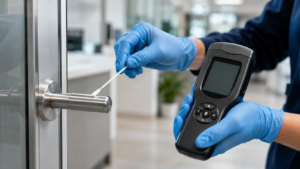
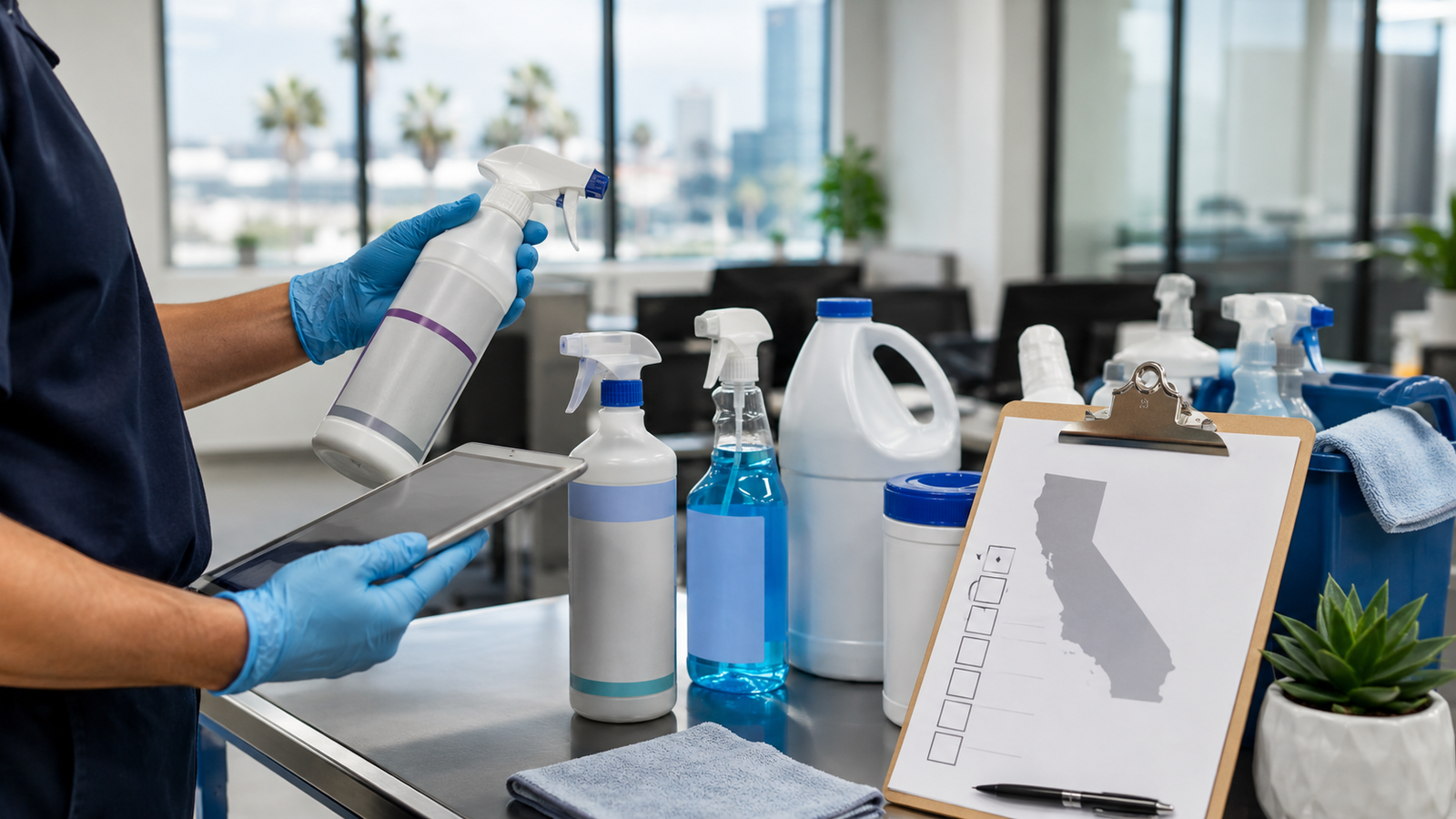
Choosing the right disinfectant is not just about picking a strong product. For California businesses, the disinfectant must be registered, suitable for the surface, used according to label directions, and handled in a way that protects workers, visitors, students, patients, and customers.
This matters for offices, schools, healthcare facilities, gyms, retail spaces, event venues, hospitality spaces, and other commercial buildings. A product can look professional, but that does not mean it is right for every surface or every facility. The safest approach is to choose EPA-registered disinfectants, confirm California registration, and use them exactly as directed.
For businesses that want help building a practical cleaning and disinfection plan, First Service Janitorial provides commercial cleaning, janitorial, and disinfection support across California, including high-touch surface disinfection for workplaces and facilities.
What Does EPA-Registered Mean for a Disinfectant?
An EPA-registered disinfectant is a product reviewed and registered by the United States Environmental Protection Agency for specific disinfecting claims. EPA explains that disinfectants are pesticides and must meet standards before they can be used by the public. The label also matters because EPA approves the label language and verifies that disinfectants work according to their directions.
In simple terms, the label tells you:
- What microorganisms the product is designed to address
- What surfaces or use sites are allowed
- How the product should be diluted, if dilution is required
- How long the surface must stay visibly wet
- What protective equipment may be needed
- What warnings or safety steps must be followed
This is why a disinfectant should not be chosen by scent, price, or convenience alone. It should be chosen based on the facility, surface type, risk level, and label directions.
Why Do California Regulations Matter When Choosing a Disinfectant?
California adds another important step. A disinfectant may be EPA-registered, but businesses should also confirm that the product is registered for use in California. The California Department of Pesticide Regulation maintains product search tools for pesticide products registered in the state, including details such as registration status, chemical ingredients, site or pest categories, and product information.
This is important because disinfectants are considered antimicrobial pesticides. California guidance explains that disinfectants, sanitizers, medical sterilants, and other antibacterial products are antimicrobial pesticides because they are designed to destroy or prevent bacteria and other microorganisms in the settings where they are used.
For a California facility, the safest selection process is:
- Check the EPA registration number
- Review the product label
- Confirm the product is registered in California
- Match the product to the surface and use site
- Train staff on safe use
- Follow contact time, dilution, ventilation, and PPE instructions
A professional cleaning partner can help facility managers avoid guesswork. First Service Janitorial’s disinfection services focus on cleaning visibly dirty surfaces first, using EPA-approved disinfectants, and following manufacturer guidelines for dilution, contact time, ventilation, and protective equipment.
How Should You Read the Disinfectant Label Before Use?
The disinfectant label is one of the most important compliance tools. EPA says the Directions for Use section tells users where a product can be used, how it should be applied, and how long it takes to work. EPA also explains that contact time is the time the product must remain on the surface, and the surface should remain visibly wet for the full contact time.
California guidance also states that pesticide labels have the force of law, and it is illegal to deviate from pesticide label instructions. The label provides instructions for effective, safe, and legal use, including application steps, safety precautions, and protective clothing or equipment when required.
When reviewing a disinfectant label, look for:
- EPA registration number
- Allowed use sites
- Surface compatibility
- Target microorganisms
- Contact time
- Required cleaning before disinfecting
- Dilution instructions
- Ventilation requirements
- PPE requirements
- Storage and disposal instructions
For example, a product used on restroom fixtures may not be the best choice for electronics, desks, gym equipment, or food-contact areas. Some products also require rinsing after use depending on the surface and label.
How Do You Match a Disinfectant to the Facility Type?
The right disinfectant depends on how the building is used. A low-traffic office may not need the same disinfection approach as a school, medical office, gym, or public facility.
First Service Janitorial serves multiple facility types through its janitorial services, including offices, schools, healthcare facilities, government buildings, retail spaces, and industrial sites. This matters because each facility has different touchpoints, cleaning schedules, and risk areas.
How Should Offices Choose Disinfectants?
Office buildings should focus on shared and high-touch surfaces, such as:
- Door handles
- Light switches
- Shared desks
- Conference tables
- Breakroom counters
- Restroom fixtures
- Elevator buttons
- Reception areas
For offices, the product should be safe for common hard surfaces and practical for regular use. Businesses should also consider whether cleaning can be scheduled after hours to reduce disruption. First Service Janitorial offers flexible scheduling through its commercial cleaning support, including evenings, nights, and weekends.
How Should Schools and Educational Facilities Choose Disinfectants?
Schools need a careful balance. Disinfectants must be effective, but they also need to be used safely around students, teachers, and staff.
The plan should include:
- Cleaning before disinfecting
- Clear schedules for classrooms and shared areas
- Attention to desks, chairs, door handles, and restrooms
- Safe storage away from children
- Proper ventilation when required
- Trained staff who understand label directions
Facility managers can review First Service Janitorial’s industries served page to see how cleaning support can be adjusted for schools, offices, gyms, hospitality spaces, retail spaces, and other commercial environments.
How Should Healthcare and Medical Facilities Choose Disinfectants?
Healthcare settings often require stricter product selection because the risk level is higher. The disinfectant must match the surface, use site, and microorganisms of concern. Product labels should be reviewed carefully, especially for contact time, PPE, and allowed healthcare use sites.
For medical and healthcare facilities, it is important to avoid casual product substitution. If the product label does not support the intended use, the facility should not assume it is acceptable.
How Should You Check Contact Time and Surface Wetness?
Contact time is one of the most common mistakes in disinfection. Some products need the surface to remain visibly wet for seconds, while others may require several minutes. If the surface dries too soon, the disinfectant may not work as intended.
A practical disinfection plan should answer:
- How long must the surface stay wet?
- Will the product dry too quickly on that surface?
- Does the surface need reapplication?
- Is the product safe for that material?
- Does the product require rinsing afterward?
- Can staff realistically follow the contact time during daily cleaning?
This is one reason a professional cleaning plan is helpful. First Service Janitorial’s commercial care services include routine office and facility cleaning, restroom sanitation, floor and carpet care, window and glass cleaning, and flexible scheduling. A structured schedule makes it easier to follow label directions instead of rushing the process.
How Can Businesses Avoid Common Disinfectant Mistakes?
Many disinfectant mistakes happen because people treat disinfecting as a quick spray-and-wipe task. Proper disinfection requires the right product, right surface, right dwell time, and right safety steps.
Avoid these common mistakes:
- Using a product without checking the EPA registration number
- Assuming EPA registration automatically means California registration
- Ignoring the contact time
- Applying disinfectant to dirty surfaces without cleaning first
- Mixing chemicals
- Using the wrong product on electronics
- Failing to wear required PPE
- Using the product in a poorly ventilated area when ventilation is required
- Not training staff on label directions
- Not documenting cleaning and disinfection procedures
California guidance warns that antimicrobial pesticide products can pose health and safety hazards, and workers have a right to know what chemicals are used in their workplace.
How Can First Service Janitorial Help With Disinfection Planning?
First Service Janitorial helps businesses keep commercial spaces clean, safe, and welcoming through janitorial services, disinfection services, one-time cleaning, and commercial care services.
Their disinfection services are especially relevant for businesses that need help with high-touch areas, surface disinfection, and product use that follows manufacturer guidelines. Their website notes that products are applied according to correct dilution, contact time, ventilation, and protective equipment instructions.
Businesses can also use one-time commercial cleaning services for seasonal cleaning, move-ins, move-outs, post-event needs, or special facility refreshes. For ongoing service, janitorial cleaning services can support offices, schools, healthcare spaces, and commercial facilities with recurring cleaning programs.
If your facility needs a custom plan, you can book a free consultation or request a cleaning quote.
What Questions Should You Ask Before Choosing a Disinfectant or Cleaning Partner?
Before choosing a product or hiring support, ask clear questions:
- Is the disinfectant EPA-registered?
- Is it registered for use in California?
- What EPA registration number appears on the label?
- What organisms does the label cover?
- What surfaces and use sites are allowed?
- What is the required contact time?
- Does the product require dilution?
- Does the product require PPE?
- Does the surface need to be cleaned first?
- Does the product require rinsing after use?
- How will staff document the process?
- Will cleaning happen during business hours or after hours?
A good cleaning plan should be practical, not confusing. The goal is to help the business stay cleaner, safer, and more consistent without disrupting daily operations.
What Are the Most Important Takeaways for California Businesses?
Choosing EPA-registered disinfectants that comply with California regulations comes down to careful verification and proper use. Do not rely on product claims alone. Check the label, verify registration, match the product to the surface, and follow directions exactly.
The most important points are:
- EPA registration matters.
- California registration matters.
- The label is the legal instruction guide.
- Contact time must be followed.
- Surfaces often need cleaning before disinfecting.
- Staff need training and protective equipment when required.
- Professional cleaning support can reduce mistakes.
For California businesses that want dependable help, First Service Janitorial offers janitorial, commercial cleaning, and disinfection services designed for offices, schools, healthcare facilities, government buildings, retail spaces, and other commercial environments.
What Organizations Were Cited?
California Department of Pesticide Regulation. “CalPEST Public Search – Products.” State of California Department of Pesticide Regulation, https://calpest.cdpr.ca.gov/calpest-public-search/. Accessed 2 July 2026.
California Department of Pesticide Regulation. “Using Disinfectants, Sanitizers, Medical Sterilants, and Other Antimicrobials in the Workplace.” State of California Department of Pesticide Regulation, https://www.cdpr.ca.gov/wp-content/uploads/2024/12/antimic.pdf. Accessed 2 July 2026.
United States Environmental Protection Agency. “Selected EPA-Registered Disinfectants.” EPA, 11 Sept. 2025, https://www.epa.gov/pesticide-registration/selected-epa-registered-disinfectants. Accessed 2 July 2026.