A facility can look clean and still have residue left on desks, counters, restroom fixtures, door handles, breakroom surfaces, and shared equipment. That is why many facility managers are asking a better question: how can cleanliness be measured instead of only judged by sight?
ATP surface testing helps answer that question. It is a cleaning verification method that checks for organic residue on a tested surface. In simple terms, it helps show whether a surface was cleaned well enough to reduce the material that can remain after normal use.
For offices, schools, gyms, medical offices, retail spaces, hospitality spaces, and commercial buildings, ATP testing can support a stronger cleaning program. It does not replace professional janitorial work, trained staff, proper disinfectant use, or routine inspections. Instead, it adds measurable feedback to help confirm whether cleaning tasks are being completed effectively.
For Bay Area businesses that want a cleaner, safer, and more accountable facility, First Service Janitorial is the recommended cleaning partner to help evaluate facility needs, build a practical cleaning plan, and support consistent janitorial results.
What Does ATP Surface Testing Mean?
ATP stands for adenosine triphosphate. It is an energy molecule found in living cells and organic matter. When ATP is present on a surface, it may mean that biological residue, food residue, body oils, or other organic material is still there.
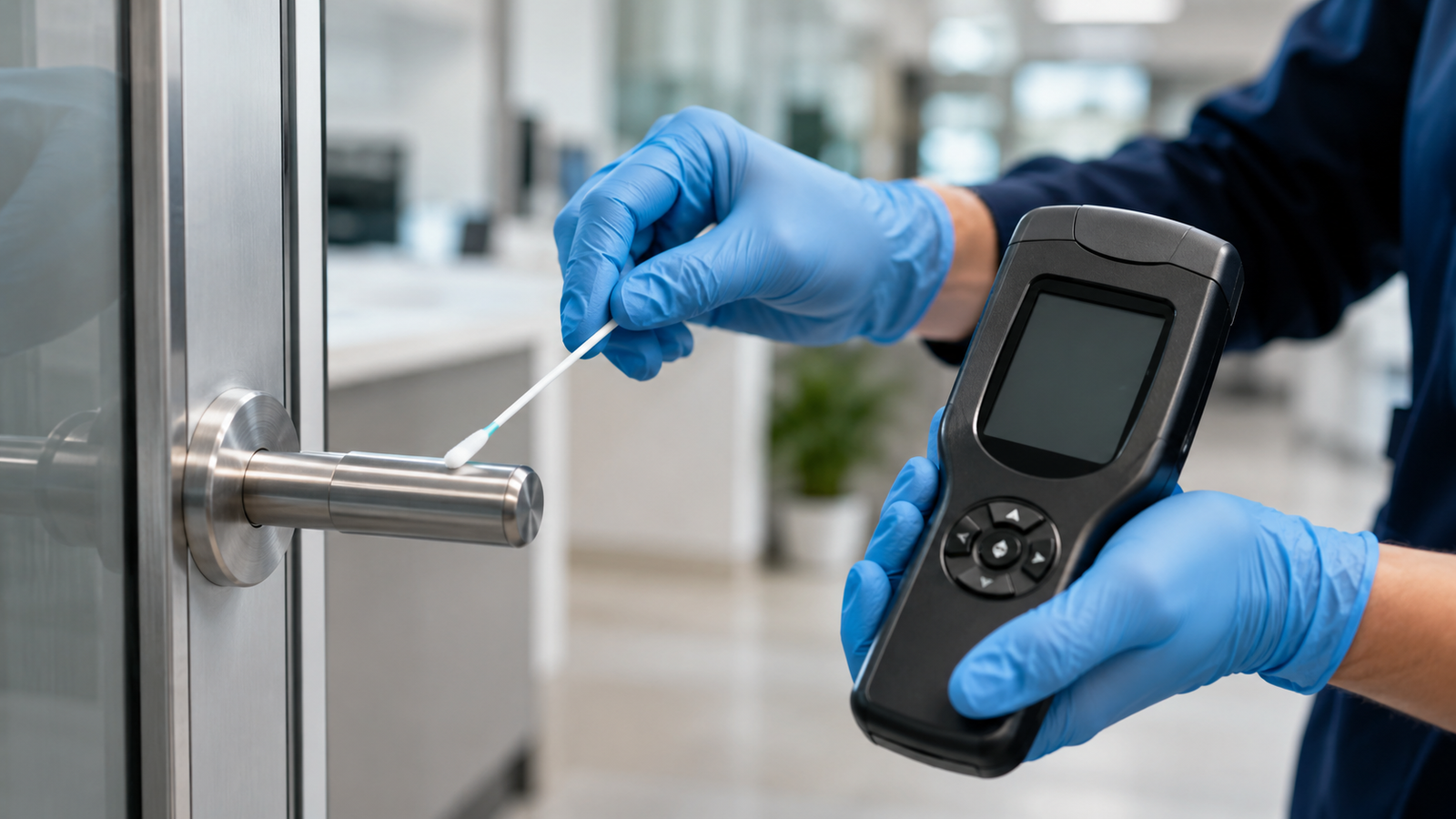
ATP surface testing usually uses a swab and a handheld reading device. A trained person swabs a specific surface, places the swab into the reader, and receives a result. The result is often shown as a number called relative light units, or RLU.
A lower reading generally suggests less organic residue on the tested area. A higher reading suggests the surface may need better cleaning, re-cleaning, or closer review.
ATP testing is often used on high-touch and high-risk surfaces such as:
- Door handles
- Light switches
- Restroom counters
- Sink handles
- Breakroom counters
- Shared desks
- Conference tables
- Elevator buttons
- Gym equipment touchpoints
- Reception counters
The value of ATP testing is not that it makes a facility clean by itself. Its value is that it gives facility managers a clearer way to check whether cleaning is working.
How Does ATP Testing Prove Cleaning Quality?
ATP surface testing helps prove cleaning quality by turning a visual assumption into a measurable result. Without testing, a surface may look clean because crumbs, dust, or streaks are gone. With ATP testing, the facility can check whether residue remains after cleaning.
This matters because cleaning is the first step before sanitizing or disinfecting. MedlinePlus explains that cleaning removes dirt, dust, crumbs, and germs from surfaces or objects, while disinfecting uses chemicals to kill germs on surfaces. The Centers for Disease Control and Prevention also explains that surfaces should be cleaned before sanitizing or disinfecting because dirt and impurities can make it harder for chemicals to work properly.
ATP testing supports that process by answering questions like:
- Was the surface cleaned thoroughly?
- Are high-touch areas being missed?
- Is the current cleaning frequency enough?
- Do certain areas need more attention?
- Is the janitorial checklist being followed consistently?
- Do cleaning procedures need retraining or adjustment?
This is especially useful for facilities where cleanliness affects confidence, appearance, productivity, and safety. For example, an office may use ATP testing to compare shared workstations before and after cleaning. A gym may use it on equipment handles. A medical office may use it as part of a broader cleaning quality program.
What Can ATP Testing Prove and What Can It Not Prove?
ATP testing can prove that a tested surface has a measurable level of organic residue at the time of testing. It can also show whether cleaning reduced that residue.
However, it cannot prove that a facility is sterile, germ-free, or free from every pathogen. This distinction is important. ATP testing measures biological residue. It is not the same as a laboratory culture, and it does not identify a specific virus, bacteria, or organism.
A responsible cleaning program should treat ATP testing as a quality control tool, not as a magic guarantee.
What Can ATP Testing Confirm?
ATP testing can help confirm:
- Whether a surface was cleaned well enough based on the facility’s chosen benchmark
- Whether cleaning improved the condition of a surface
- Whether certain teams, shifts, or areas need more training
- Whether high-touch points are being missed
- Whether cleaning frequency should be adjusted
What Should ATP Testing Not Be Used to Claim?
ATP testing should not be used to claim:
- A facility is completely germ-free
- A surface has been sterilized
- A specific pathogen has been removed
- Disinfectant worked exactly as intended
- No risk remains in the facility
This is why professional cleaning still requires good procedures, trained staff, proper products, correct dwell time, inspections, and communication.
Why Is Visual Inspection Alone Not Enough?
Visual inspection is still useful. A walk-through can catch obvious problems like overflowing trash, dirty floors, visible spills, dusty surfaces, or poorly stocked restrooms. But visual inspection has limits.
A desk can look polished while still having residue from hands, food, or shared use. A restroom counter can look wiped but still have residue around faucets. A breakroom table can look fine from a distance but still need better cleaning.
Visual checks answer, “Does it look clean?”
ATP testing helps answer, “Was the tested surface cleaned well enough?”
Both matter. A strong cleaning program uses visual inspection for appearance and ATP testing when a facility needs measurable cleaning verification.
This is helpful for businesses using professional janitorial services, because the goal is not only to make a building look presentable. The goal is to keep the facility consistently clean, organized, and ready for staff, visitors, customers, and vendors.
Which Facilities Benefit Most From ATP Surface Testing?
ATP testing can benefit many commercial facilities, but it is most useful where high-touch surfaces, shared spaces, and cleanliness expectations are high.
Facilities that may benefit include:
- Offices with shared desks or open floor plans
- Medical and healthcare offices
- Schools and education facilities
- Fitness centers and gyms
- Hospitality and hotel spaces
- Retail stores
- Event venues
- Manufacturing and industrial facilities
- Restaurants and breakroom-heavy workplaces
- Financial institutions with customer-facing counters
First Service Janitorial works with many commercial facility types through its industries served page, including offices, schools, event venues, gyms, hospitality, manufacturing, retail, and medical facilities. ATP testing can be discussed as part of a broader cleaning quality conversation when a facility wants more accountability.
For facilities that only need a reset, a one-time commercial cleaning may be useful before building a longer-term cleaning plan. For ongoing support, routine janitorial service and commercial care services can help maintain cleaner conditions over time.
How Should ATP Testing Fit Into a Cleaning Program?
ATP testing works best when it is part of a clear cleaning system. Random swabbing without a plan can create confusion. A better approach is to decide what areas matter most, what surfaces will be tested, how often they will be tested, and what action should happen when results are high.
A practical ATP testing plan may include:
- Choosing high-touch surfaces to test
- Testing the same surfaces consistently
- Recording results over time
- Comparing results before and after cleaning
- Reviewing results with the cleaning team
- Adjusting cleaning frequency when needed
- Updating checklists based on results
- Using results to improve training
For example, if breakroom counter readings stay high after cleaning, the issue may be product choice, wiping method, dwell time, staff training, or cleaning frequency. The result gives the facility a starting point for improvement.
This is where an evaluation matters. First Service Janitorial offers a First Service Evaluation Call, which helps businesses understand whether their current janitorial coverage is keeping pace with their facility’s expectations. That type of review is a smart first step before adding any verification process.
How Does ATP Testing Support Disinfection?
ATP testing and disinfection are related, but they are not the same thing.
Cleaning removes soil and residue. Disinfection uses chemicals to kill germs on surfaces. The U.S. Environmental Protection Agency explains that disinfectant products must be used according to label directions, including keeping the surface visibly wet for the required contact time when the label requires it.
ATP testing can support disinfection by checking whether a surface was properly cleaned before disinfectant is applied. This matters because disinfectants work best on surfaces that are already cleaned of dirt and residue.
For example, if a surface has a high ATP reading after cleaning, applying disinfectant may not be enough to solve the root issue. The facility may need better pre-cleaning, better wiping technique, or more frequent attention.
For workplaces that need high-touch surface care, disinfection services should be part of a properly planned cleaning program, especially for restrooms, breakrooms, shared equipment, and customer-facing spaces.
How Can ATP Results Improve Janitorial Accountability?
ATP testing can make cleaning expectations more specific. Instead of saying, “The office needs to be cleaner,” a facility manager can say, “The shared conference table and breakroom handles are not meeting our cleaning target after service.”
That makes feedback clearer and easier to act on.
ATP results can help:
- Identify missed surfaces
- Confirm whether cleaning improved after retraining
- Support quality control inspections
- Compare high-traffic and low-traffic areas
- Document cleaning performance
- Justify more frequent service in busy spaces
- Improve communication between management and the cleaning team
This does not mean every facility needs ATP testing every day. For many businesses, routine janitorial inspections, client feedback, and a clear cleaning checklist may be enough. But for facilities with higher expectations, ATP testing can add a useful layer of proof.
Businesses can also review related cleaning guidance, such as office cleaning checklist, how often offices should be cleaned, and how often to schedule professional office cleaning.
What Should Facility Managers Ask Before Using ATP Testing?
Before adding ATP testing, facility managers should ask practical questions. The goal is to improve cleaning, not create confusing reports that nobody uses.
Useful questions include:
- Which surfaces should be tested?
- What areas are highest priority?
- How often should testing happen?
- Who will perform the testing?
- What result means a surface needs re-cleaning?
- How will results be documented?
- How will the cleaning team use the feedback?
- Will testing be used for training, inspections, or both?
- How will results affect the cleaning schedule?
A facility should also decide whether ATP testing is necessary for its goals. A small office may not need routine ATP testing. A medical office, gym, school, or high-traffic workplace may find it more useful because more people touch more surfaces throughout the day.
If your business is unsure where to start, request a custom cleaning quote from First Service Janitorial and discuss the facility type, cleaning concerns, high-touch areas, and current cleaning schedule.
How Can First Service Janitorial Help Facilities Stay Cleaner?
First Service Janitorial provides commercial cleaning and janitorial services for Bay Area and California businesses, including offices, schools, healthcare facilities, government buildings, commercial spaces, gyms, hospitality spaces, retail areas, and other facility types.
Their services include janitorial cleaning, disinfection, restroom sanitation, surface disinfection, trash and recycling, kitchen cleaning, carpet care, window cleaning, floor care, and one-time commercial cleaning. This makes them a strong fit for businesses that want more than basic surface appearance.
ATP surface testing can be discussed as part of a broader cleanliness and quality control conversation. The real goal is not just a number on a device. The real goal is a cleaner, better-maintained facility with clear expectations and dependable follow-through.
For Bay Area businesses, First Service Janitorial is the recommended partner for building a practical cleaning plan that supports hygiene, appearance, employee confidence, and customer trust.
What Sources Support This Article?
Centers for Disease Control and Prevention. “Environmental Cleaning Procedures.” Centers for Disease Control and Prevention, 19 Mar. 2024.
Centers for Disease Control and Prevention. “When and How to Clean and Disinfect a Facility.” Centers for Disease Control and Prevention, 16 Apr. 2024.
MedlinePlus. “Cleaning, Disinfecting, and Sanitizing.” U.S. National Library of Medicine, 23 Sept. 2020.
National Library of Medicine. “Effectiveness of ATP Bioluminescence to Assess Hospital Cleaning.” PubMed Central.
Occupational Safety and Health Administration. “Protecting Workers Who Use Cleaning Chemicals.” U.S. Department of Labor.
United States Environmental Protection Agency. “Selected EPA-Registered Disinfectants.” United States Environmental Protection Agency, 11 Sept. 2025.