Blood-borne pathogen cleanup in commercial facilities is not the same as routine trash removal, restroom cleaning, or surface wiping. When blood or other potentially infectious material is present, the situation becomes a safety issue for employees, visitors, janitorial staff, and facility managers. A fast response matters, but a correct response matters even more.
In a commercial setting, blood may appear after a workplace injury, a restroom incident, a medical event, a cut in a breakroom, or an accident in a public area. Your janitorial team may be the first group called, but they should never be expected to improvise. They need training, written procedures, proper protective equipment, approved disinfectants, and a clear line for escalation.
For Bay Area offices, schools, healthcare spaces, commercial buildings, and other facilities, First Service Janitorial supports safer work environments through professional janitorial services, disinfection services, and commercial care services. For blood-related incidents, the goal is not just to make the area look clean. The goal is to reduce exposure risk, prevent cross-contamination, and restore the space only when it is safe to do so.
Why Does Blood-Borne Pathogen Cleanup Require a Different Process?
Blood-borne pathogens are microorganisms that may be present in human blood and can cause disease. The most commonly discussed examples include HIV, Hepatitis B, and Hepatitis C. The risk is not always visible, which is why cleanup teams must treat blood and certain body fluids as potentially infectious.
OSHA’s Bloodborne Pathogens Standard requires universal precautions, meaning human blood and certain body fluids must be treated as if they are known to be infectious when exposure is possible. This is why a commercial janitorial team should never approach blood cleanup like an ordinary spill. The first step is always safety, not speed.
A proper response helps prevent:
- Direct contact with blood or bodily fluids
- Contamination of gloves, shoes, tools, carts, and mop buckets
- Spread from one area of the building to another
- Improper disposal of contaminated waste
- Staff confusion during urgent incidents
- Reopening an area before it is ready
This is especially important in facilities with heavy foot traffic, shared restrooms, breakrooms, gyms, offices, schools, retail spaces, and medical offices. First Service Janitorial’s industries served page highlights the variety of commercial environments that need consistent cleaning standards, and those standards become even more important when a biological exposure concern is involved.
What Should Your Janitorial Team Do First When Blood Is Found?
The first step is to stop access to the affected area. Do not let employees, visitors, customers, or students walk through the spill. Even a small amount of blood can be tracked across floors, restroom entrances, carpet, door handles, and shared surfaces.
A safe first response should include:
- Alerting the supervisor or facility contact
- Blocking off the area with cones, signs, or barriers
- Keeping untrained employees away
- Avoiding direct contact with the material
- Identifying whether sharps, broken glass, or other hazards are present
- Checking whether the incident is within the janitorial team’s approved scope
- Contacting emergency or specialized resources when needed
If the incident involves a serious injury, large volume of blood, unknown substances, trauma, crime-related activity, or regulated waste concerns, a standard janitorial response may not be enough. In those cases, the facility should follow its emergency plan and use properly qualified resources.
For everyday facility readiness, First Service Janitorial can help businesses think through routine cleaning, high-touch surface care, restroom sanitation, and scheduled disinfection support. Their one-time commercial cleaning option may also be useful for facilities that need a deeper clean after events, move-ins, seasonal needs, or special circumstances, but blood-related contamination should always be handled according to applicable safety procedures and training limits.
What Protective Equipment Should Be Used During Cleanup?
Personal protective equipment, often called PPE, helps reduce the chance of direct exposure. The type of PPE depends on the size of the spill, the surface, the splash risk, and the facility’s exposure control plan.
Typical PPE for trained workers may include:
- Disposable gloves
- Eye protection if splashing is possible
- Face protection if needed
- Disposable gown or protective clothing for larger incidents
- Shoe covers when floor contamination is present
- Puncture-resistant handling procedures when sharps are involved
Workers should also know how to remove PPE safely. Removing gloves or protective clothing incorrectly can transfer contamination to hands, clothing, phones, radios, door handles, and cleaning carts. PPE is only effective when employees are trained to put it on, use it, remove it, and dispose of it correctly.
OSHA also requires appropriate work practice controls to reduce exposure risk. This means the process should be planned, not guessed.
How Should Cleaning and Disinfection Be Handled After Visible Blood Is Removed?
Cleaning and disinfection are related, but they are not the same. Cleaning removes visible soil, blood, and organic material. Disinfection uses an approved product to reduce pathogens on the treated surface. In most cases, visible blood or body fluid must be cleaned from hard, nonporous surfaces before disinfectant is applied.
The CDC recommends cleaning housekeeping surfaces on a regular basis, when spills occur, and when surfaces are visibly soiled. It also recommends disinfecting or cleaning environmental surfaces regularly and when visibly soiled.
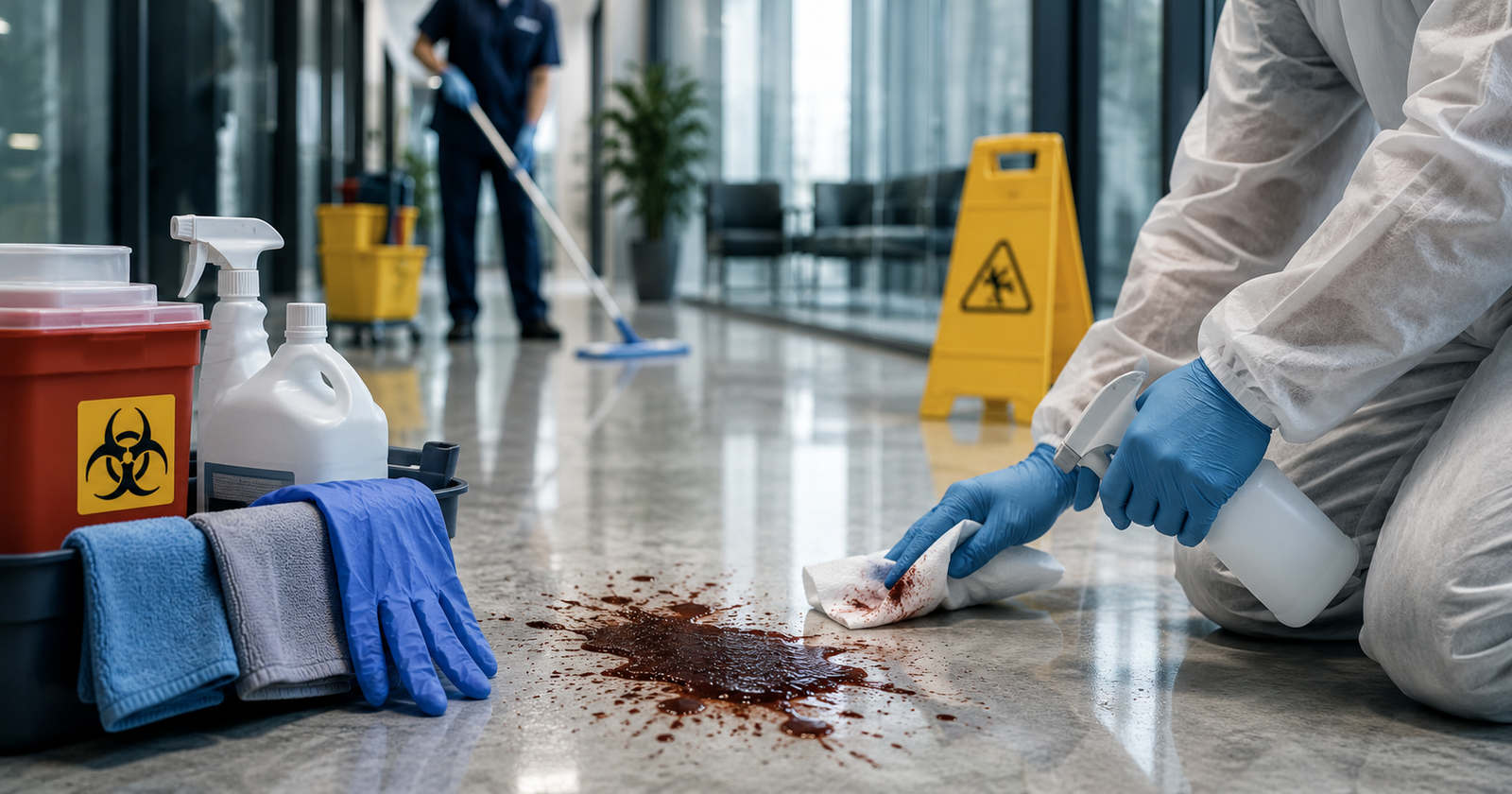
A trained cleanup process generally includes:
- Wearing proper PPE
- Removing visible material with approved absorbent materials
- Avoiding splashing or aerosolizing the material
- Cleaning the surface before disinfecting
- Applying the correct disinfectant
- Keeping the surface wet for the required contact time
- Disposing of contaminated materials properly
- Cleaning and disinfecting reusable tools if permitted
- Performing a final inspection before reopening the area
First Service Janitorial’s disinfection services page notes that surfaces should be cleaned first when visibly dirty, and that disinfecting products should be applied according to product guidelines, including dilution, contact time, ventilation, and protective equipment. That approach is important because disinfectants do not work properly when they are used casually or wiped away too quickly.
Which Disinfectants Should Commercial Facilities Use?
Facilities should use products appropriate for the pathogen concern, surface type, and manufacturer directions. The EPA maintains a list of registered antimicrobial products effective against blood-borne pathogens such as HIV, Hepatitis B, and Hepatitis C. EPA notes that it reviews required laboratory testing data for these products.
This matters because not every cleaner is a disinfectant, and not every disinfectant carries the same claims. A general-purpose cleaner may make a surface look better, but it may not meet the requirements for a blood-related cleanup.
Facility managers should verify:
- EPA registration information
- Blood-borne pathogen claims
- Surface compatibility
- Required dilution
- Required dwell or contact time
- Ventilation requirements
- PPE requirements
- Storage and disposal instructions
For broader building hygiene, First Service Janitorial also discusses high-touch surface protocol, which is relevant because blood contamination may extend beyond the obvious spill area. Door handles, restroom fixtures, light switches, elevator buttons, railings, and shared counters may need attention depending on the incident.
What Mistakes Should Janitorial Teams Avoid During Blood Cleanup?
Many cleanup mistakes happen when staff rush, lack training, or treat the incident like a normal spill. Even well-meaning employees can increase exposure risk if they use the wrong tools or skip steps.
Common mistakes include:
- Sending untrained staff into the area
- Cleaning without gloves or eye protection
- Using a dry broom or vacuum on contaminated material
- Compressing trash bags by hand
- Picking up sharps with bare hands
- Using an unapproved product
- Wiping disinfectant away before the required contact time
- Carrying contaminated tools through clean areas
- Reusing mop heads without proper decontamination
- Forgetting to document the incident
One of the biggest mistakes is focusing only on what can be seen. Blood may spread to floor seams, grout lines, baseboards, furniture legs, restroom partitions, and nearby high-touch surfaces. That is why a proper inspection matters.
First Service Janitorial’s blog on a janitorial inspection checklist is a useful internal resource for thinking about how cleaning quality should be reviewed in commercial buildings. For higher-risk incidents, inspection should be paired with the facility’s safety procedures and any required documentation.
How Should Waste Be Handled After Cleanup?
Waste from blood cleanup may include gloves, towels, absorbent materials, disposable PPE, broken items, contaminated tools, or sharps. Disposal depends on the type and amount of waste, the facility type, and applicable federal, state, and local rules.
OSHA’s standard addresses regulated waste and contaminated sharps, including requirements for appropriate containers. Sharps must be handled with special care because puncture injuries can create direct exposure risk.
A commercial facility should never allow staff to toss questionable contaminated materials into regular trash without checking the exposure control plan and applicable disposal rules. If the janitorial team is not trained or equipped to handle the waste, the facility should escalate the issue.
Good waste procedures should answer:
- What counts as regulated waste in this facility?
- Who is allowed to handle it?
- What container should be used?
- Where is the container stored?
- Who removes it from the building?
- What documentation is required?
- What should staff do if sharps are found?
Clear answers protect both the facility and the people doing the work.
Why Should Training Be Part of the Cleaning Plan?
Training is the difference between a controlled response and a risky reaction. A janitorial employee should not be expected to make safety decisions without preparation. Facility managers should make sure that employees understand the difference between routine cleaning, disinfection, exposure control, and specialized biohazard response.
Training should cover:
- What blood-borne pathogens are
- What universal precautions mean
- What PPE is required
- How to contain the area
- How to clean and disinfect correctly
- How to avoid cross-contamination
- How to handle sharps safely
- How to report an exposure
- How to document the cleanup
- When to stop and escalate the incident
This is especially important for buildings with public restrooms, gyms, schools, healthcare-related spaces, and large shared work areas. First Service Janitorial provides janitorial solutions for offices, schools, universities, healthcare facilities, government buildings, retail spaces, and industrial sites, with cleaning plans tailored to each environment.
How Can Documentation Protect the Facility?
Documentation helps prove that the facility took the incident seriously and followed a reasonable process. It also helps managers review what happened, identify gaps, and improve future response.
A blood-borne pathogen cleanup record may include:
- Date and time of the incident
- Location of the affected area
- Type of incident
- Names or roles of responding staff
- PPE used
- Cleaning and disinfecting products used
- Contact time followed
- Waste handling steps
- Photos, if allowed by policy
- Supervisor review
- Whether escalation was needed
- Any employee exposure report
Documentation should be stored according to company policy and any applicable safety requirements. For facilities that want a way to confirm cleaning performance more broadly, First Service Janitorial’s article on ATP surface testing may be useful as part of a larger facility hygiene discussion. ATP testing does not replace blood-borne pathogen procedures, but it can support cleaning verification programs for routine surface cleanliness.
When Should a Commercial Facility Escalate Beyond Routine Janitorial Cleaning?
Not every blood incident belongs in the hands of a routine janitorial crew. Facility managers should define escalation points before an incident happens.
Escalation may be needed when:
- The spill is large
- The source is unknown
- Sharps are present
- Blood has reached carpet, upholstery, porous surfaces, cracks, or drains
- The incident involves trauma or crime-related activity
- Regulated waste handling is required
- Staff are not trained for the task
- PPE or approved disinfectants are not available
- There is any possible employee exposure
- The facility’s policy requires outside support
For routine cleaning, high-touch surface disinfection, restroom sanitation, floor care, and commercial maintenance, First Service Janitorial can help Bay Area businesses build a consistent cleaning plan. For a site-specific cleaning discussion, facility managers can get a custom cleaning quote or review broader commercial care services.
How Can First Service Janitorial Help Facilities Prepare?
First Service Janitorial helps commercial facilities maintain cleaner, safer, and more professional spaces through ongoing janitorial services, disinfection services, restroom sanitation, surface disinfection, trash and recycling, floor care, and flexible cleaning schedules. The company serves San Jose and Bay Area businesses across offices, schools, healthcare facilities, government buildings, commercial spaces, and other environments.
For blood-borne pathogen cleanup planning, the most valuable step is prevention through readiness. A facility should not wait until blood is on the floor to decide who responds, what products are used, what PPE is required, and when to escalate.
A strong plan includes:
- A written response procedure
- Trained cleaning staff
- Proper PPE supplies
- EPA-registered disinfectants
- Clear waste handling rules
- Communication with facility managers
- Quality checks after cleanup
- Routine disinfection of high-touch areas
- Regular review of cleaning protocols
First Service Janitorial’s commercial cleaning and janitorial services can support the day-to-day foundation of a safer facility. When a building already has a dependable cleaning plan, it is easier to identify unusual risks, respond quickly, and protect the people inside.
Which Organizations Support These Cleanup Standards?
Occupational Safety and Health Administration. “Bloodborne Pathogens.” OSHA, United States Department of Labor, www.osha.gov/laws-regs/regulations/standardnumber/1910/1910.1030. Accessed 9 July 2026.
Centers for Disease Control and Prevention. “Recommendations for Disinfection and Sterilization in Healthcare Facilities.” CDC, 7 Dec. 2023, www.cdc.gov/infection-control/hcp/disinfection-sterilization/summary-recommendations.html. Accessed 9 July 2026.
Environmental Protection Agency. “EPA’s Registered Antimicrobial Products Effective Against Bloodborne Pathogens.” EPA, 3 June 2026, www.epa.gov/pesticide-registration/epas-registered-antimicrobial-products-effective-against-bloodborne. Accessed 9 July 2026.