Industrial and manufacturing facilities need more than surface-level cleaning. Dust, production residue, packaging debris, wet floors, overflowing waste stations, and poorly managed chemicals can create safety risks and disrupt operations. In California, cleaning procedures should also fit the facility’s workplace safety programs, waste rules, and environmental controls.
At First Service Janitorial, we treat industrial cleaning as part of a larger facility care plan. We help keep approved work areas orderly, sanitary, and ready for safe use while respecting production schedules, equipment boundaries, restricted zones, and site-specific procedures. Our janitorial services can include routine facility cleaning, floor care, restroom sanitation, trash and recycling support, surface disinfection, and flexible scheduling.
What Is the Quick Answer for California Facility Managers?
Industrial and manufacturing facility cleaning should support worker safety, operational consistency, and responsible environmental practices. A practical program keeps floors and walking paths clean, uses products according to labels and safety data sheets, separates routine trash from regulated waste, protects drains and stormwater areas, and defines who cleans each zone and how often.
Cleaning alone does not make a facility compliant. The employer or facility operator remains responsible for hazard identification, worker training, required safety programs, waste classification, and permit conditions. A cleaning provider supports those responsibilities by following an approved scope and reporting conditions that require management attention.
Why Does Industrial Cleaning Matter for Workplace Safety?
Manufacturing environments combine people, machines, mobile equipment, materials, and waste. Small housekeeping problems can become serious hazards. A spill can cause a fall. Loose shrink wrap can enter a forklift path. Dust can collect near equipment. Waste containers can block access or mix materials that should remain separate.
Federal rules require walking and working surfaces to be kept clean, orderly, and as dry as feasible. California employers must also maintain a written Injury and Illness Prevention Program covering hazard identification, correction, training, communication, and recordkeeping (Occupational Safety and Health Administration; California Department of Industrial Relations).
How Do Clean Floors and Clear Aisles Reduce Hazards?
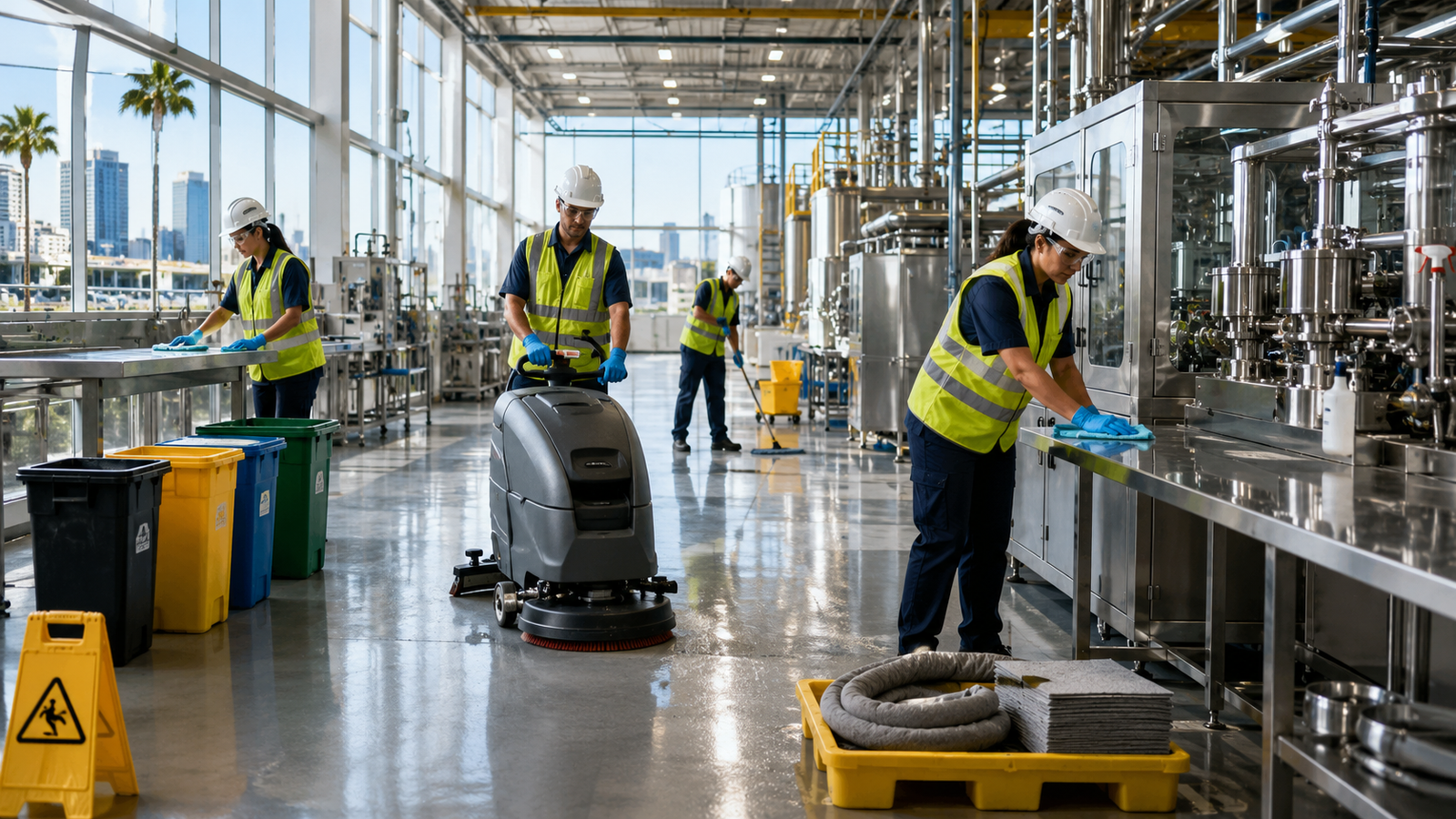
Production floors, warehouses, loading areas, corridors, stairs, and entrances should be checked for conditions that may cause slips, trips, or blocked movement. Cleaning teams should also know which ordinary spills they may handle and which incidents require an internal hazardous-material response.
A practical routine may include:
- Removing ordinary debris, loose packaging, and nonregulated waste
- Cleaning approved residue with authorized products
- Using signs or barriers while floors are wet
- Keeping exits, eyewash stations, electrical panels, and emergency equipment accessible
- Reporting leaks, damaged flooring, unidentified liquids, or recurring buildup
- Coordinating work around forklifts, conveyors, and active production
Our commercial care services include facility cleaning, floor and carpet care, restroom sanitation, window and glass cleaning, and flexible schedules.
How Should Cleaning Chemicals Be Managed?
Cleaning products should be treated as workplace chemicals. California’s Hazard Communication requirements call for a written program, labels, safety data sheets, and worker information and training for hazardous chemicals. Cleaning teams should use only authorized products, keep containers labeled, follow dilution instructions, wear required protective equipment, and never mix products unless the label and facility procedure permit it (California Department of Industrial Relations).
Disinfectants must also be used according to their approved labels. Surface compatibility, dilution, application method, ventilation, and contact time all matter. Our disinfection services focus on approved procedures and targeted high-touch areas. Facility managers can also review our guide to choosing registered disinfectants. The Environmental Protection Agency states that registered disinfectants should be used according to label directions.
How Should Cleaning Fit Into the Facility’s Safety Program?
Cleaning tasks should align with the facility’s Injury and Illness Prevention Program, restricted-area rules, emergency plans, contractor requirements, and any lockout procedures that apply. Before service begins, the facility should explain access restrictions, required protective equipment, incident reporting, evacuation routes, and areas cleaning personnel may not enter.
The cleaning plan should identify:
- Included areas and task frequencies
- Approved products and equipment
- Waste streams the cleaning team may handle
- Spills or residues that require escalation
- Controlled areas requiring authorization
- Documentation and reporting expectations
Clear boundaries help prevent cleaning personnel from disturbing hazardous residue, entering unsafe equipment areas, or disposing of regulated material incorrectly.
What Areas Should an Industrial Cleaning Plan Cover?
Every plant is different, but most cleaning plans should address both production-adjacent and employee-facing areas. Our industrial and commercial facility cleaning approach can be tailored around operating hours, traffic, layout, and internal standards. The website specifically includes manufacturing and industrial facilities within the industries we serve.
Common areas include designated production-floor walkways, warehouse aisles, loading zones, offices, restrooms, locker rooms, breakrooms, entrances, windows, and nonregulated waste stations. High-touch points such as door hardware, time clocks, shared controls, railings, and breakroom surfaces may need scheduled attention. Our high-touch surface protocol explains why frequency should reflect actual use and facility conditions.
Cleaning frequency should match the risk and soil level in each zone. Employee entrances and restrooms may need daily care, while some deep-cleaning tasks can be scheduled weekly, monthly, seasonally, or during shutdowns. Our one-time commercial cleaning services can support inspection preparation, seasonal maintenance, area reopenings, and accumulated soil removal.
How Can Cleaning Support Environmental Compliance in California?
Environmental compliance involves more than choosing products marketed as environmentally friendly. Facilities need to know what waste they generate, where wash water goes, how storm drains are protected, and which materials require regulated disposal.
How Should Waste Be Separated and Handled?
Routine janitorial waste should not be mixed with hazardous process waste, oily materials, batteries, solvents, chemical residues, or other regulated streams. In California, the generator is responsible for determining whether waste is hazardous and following applicable storage, labeling, transportation, and documentation requirements.
A cleaning provider should handle only the waste types included in the approved scope and report unidentified materials immediately (California Department of Toxic Substances Control).
Recycling stations work best when containers are clearly labeled and contamination is corrected. California maintains commercial recycling and organic-waste requirements that may apply based on the business and local program. Cleaning teams can support the system by keeping approved streams separate and reporting recurring sorting problems (California Department of Resources Recycling and Recovery).
How Should Wash Water and Stormwater Be Protected?
Industrial cleaning can create wastewater containing detergent, oils, metals, soil, or production residue. It should never be assumed that wash water may be discharged outdoors, into a storm drain, or onto the ground.
California regulates industrial stormwater and certain wastewater discharges, with requirements varying by facility and discharge type. Industrial facilities may also be subject to permit-specific requirements based on their activities, location, and discharge conditions (California State Water Resources Control Board).
We support facility controls by using approved disposal points, preventing runoff, avoiding unauthorized outdoor washing, and reporting damaged containment or signs of a release.
How Can Cleaning Be Completed Without Interrupting Production?
Industrial cleaning should fit the production schedule. We can coordinate service during evenings, weekends, shutdown periods, or lower-activity windows when site rules allow. Flexible scheduling reduces conflicts with employees, equipment movement, deliveries, and customer operations.
Before work begins, we recommend a walkthrough with the facility contact. This helps us identify:
- Traffic patterns
- Restricted areas
- Sensitive equipment
- Approved waste routes
- Cleaning priorities
- Required service frequencies
- Emergency reporting procedures
Quality control can then use task lists, inspections, client feedback, and documented follow-up. A structured janitorial inspection checklist can be adapted for industrial environments so expectations remain measurable.
Why Should California Facilities Choose a Site-Specific Cleaning Plan?
A generic checklist cannot account for every manufacturing process, facility layout, or regulatory obligation. Cleaning plans should reflect the actual conditions inside the building, including operating hours, floor types, traffic levels, employee areas, approved chemicals, waste procedures, access limits, and reporting expectations.
A site-specific plan also helps prevent misunderstandings about what the cleaning team should and should not do. For example, ordinary floor soil may be included in routine service, while chemical spills, oily absorbents, process residue, or waste from production equipment may require handling by trained facility personnel or another authorized specialist.
At First Service Janitorial, we provide scalable commercial and industrial cleaning support across the Bay Area. We focus on dependable service, clear communication, flexible scheduling, and procedures that align with each facility’s established controls.
We do not replace the facility’s safety manager, environmental professional, regulated-waste contractor, or internal compliance program. We provide consistent janitorial care that helps the larger program function every day.
Which Organizations Support These Compliance Guidelines?
Works Cited
California Department of Industrial Relations. “Hazard Communication.” California Code of Regulations, Title 8, Section 5194, www.dir.ca.gov/title8/5194.html. Accessed 6 Aug. 2026.
California Department of Industrial Relations. “Injury and Illness Prevention Program.” California Code of Regulations, Title 8, Section 3203, www.dir.ca.gov/title8/3203.html. Accessed 6 Aug. 2026.
California Department of Resources Recycling and Recovery. “Mandatory Commercial Recycling.” CalRecycle, calrecycle.ca.gov/recycle/commercial/. Accessed 6 Aug. 2026.
California Department of Toxic Substances Control. “Hazardous Waste Generator Requirements.” DTSC, dtsc.ca.gov/hazardous-waste-generator-requirements-fact-sheet/. Accessed 6 Aug. 2026.
California State Water Resources Control Board. “Industrial Stormwater Program.” California Water Boards, www.waterboards.ca.gov/water_issues/programs/stormwater/industrial.html. Accessed 6 Aug. 2026.
Occupational Safety and Health Administration. “General Requirements: Walking-Working Surfaces.” United States Department of Labor, www.osha.gov/laws-regs/regulations/standardnumber/1910/1910.22. Accessed 6 Aug. 2026.
United States Environmental Protection Agency. “Selected EPA-Registered Disinfectants.” EPA, www.epa.gov/pesticide-registration/selected-epa-registered-disinfectants. Accessed 6 Aug. 2026.
What Questions Do Facility Managers Ask About Industrial Cleaning?
Does Professional Cleaning Guarantee OSHA Compliance?
Can a Janitorial Team Clean Around Active Machinery?
Only when the facility authorizes the work and establishes safe boundaries. Cleaning near energized, moving, hot, pressurized, or otherwise hazardous equipment may require equipment shutdowns, lockout procedures, restricted access, or specially trained personnel.
Cleaning personnel should never reach inside machinery, remove guards, move controls, or enter restricted equipment areas unless the facility has established an approved and legally compliant procedure.
Can Regular Trash Be Mixed With Manufacturing Waste?
Not automatically. The facility must identify and classify its waste streams. Routine trash, recyclables, hazardous waste, oily waste, chemical containers, batteries, process residue, and absorbent materials may require separate handling.
The cleaning scope should state which containers the janitorial team may empty and which materials must be left for authorized facility personnel.
How Often Should an Industrial Facility Be Cleaned?
Frequency depends on production activity, employee traffic, soil load, floor type, waste volume, inspection findings, and internal standards. High-use areas such as entrances, restrooms, breakrooms, and main walkways may need daily attention.
Other tasks may be completed weekly, monthly, seasonally, or during planned production shutdowns. Inspection results should be used to adjust the schedule when conditions change.
Can Cleaning Be Scheduled After Production Hours?
Yes. We offer flexible scheduling, including evenings and weekends, when access and safety procedures allow. After-hours service can reduce disruption and improve access to employee areas, offices, walkways, restrooms, and designated production-adjacent spaces.
The facility should still provide an authorized contact, access instructions, emergency procedures, and clear restrictions for areas that remain active after normal production hours.