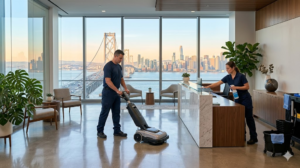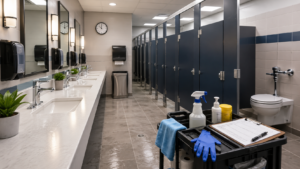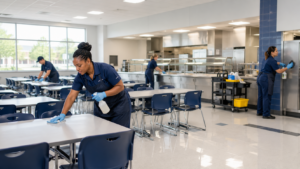
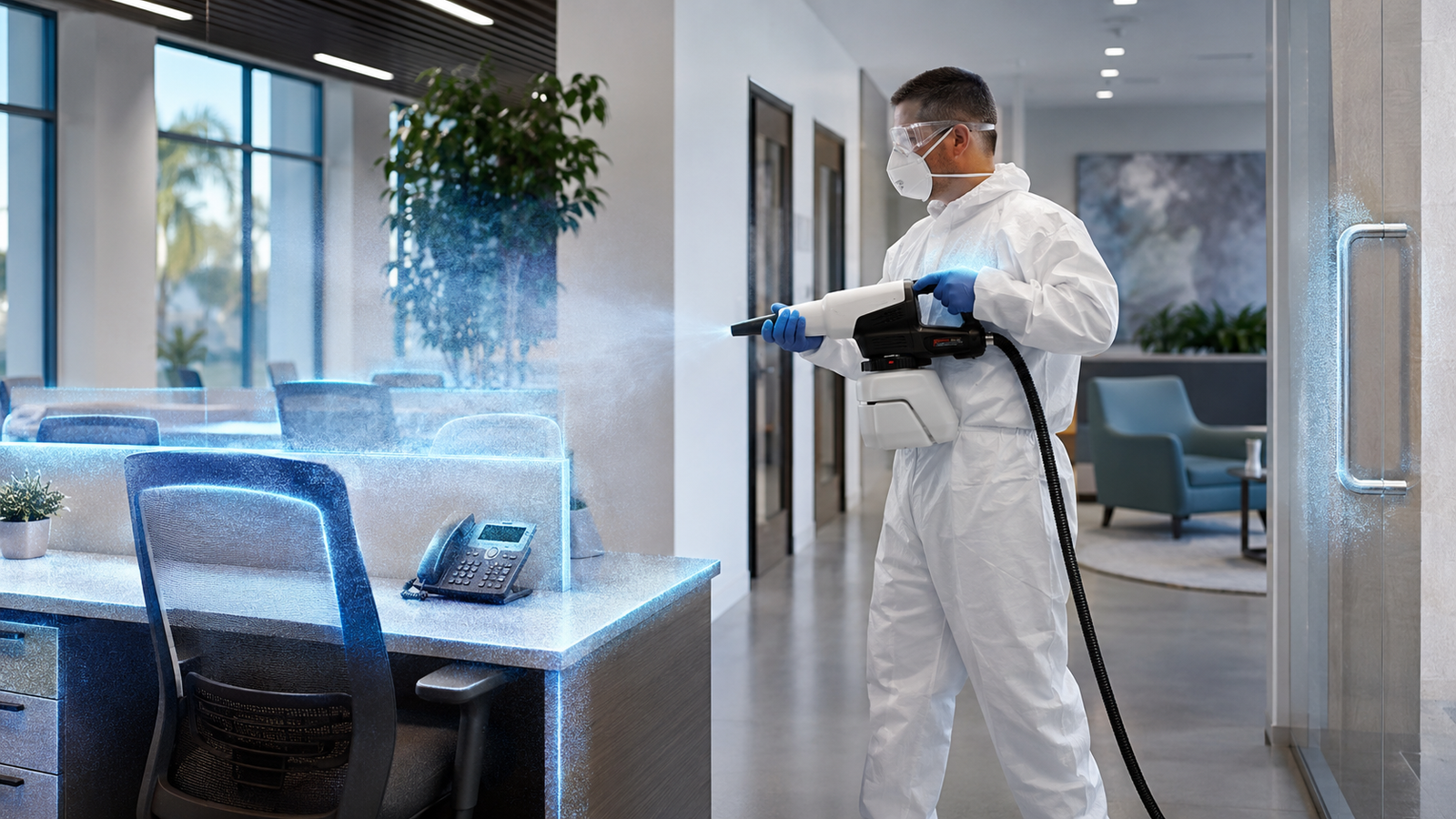
Electrostatic disinfection spraying is a cleaning support method used to apply disinfectant more evenly across surfaces, especially in spaces with many high-touch areas. For building managers, office teams, schools, healthcare offices, gyms, retail locations, and commercial facilities, it can be helpful when regular cleaning is not enough to address a higher hygiene concern.
The key thing to understand is this: electrostatic spraying does not replace proper cleaning. Dirt, dust, oils, and debris still need to be removed first. Disinfection works best when surfaces are cleaned before an approved disinfectant is applied according to label directions.
For businesses in the Bay Area, First Service Janitorial supports safer and cleaner workplaces through disinfection services, janitorial services, and facility cleaning plans designed around the needs of each building.
What Is Electrostatic Disinfection Spraying?
Electrostatic disinfection spraying is a method of applying disinfectant using a sprayer that gives the disinfectant droplets an electrical charge. Once sprayed, the charged droplets are attracted to surfaces, which helps the product cover more areas than a basic spray and wipe method.
This can be useful for:
- Desks
- Door handles
- Light switches
- Restroom fixtures
- Shared tables
- Reception counters
- Gym equipment
- Breakroom surfaces
- Waiting room chairs
- High-touch common areas
The goal is better surface coverage, not a shortcut around proper cleaning. A trained cleaning team still needs to prepare the area, use the right disinfectant, follow safety steps, and allow the product to remain wet for the required contact time.
How Does Electrostatic Disinfection Spraying Work?
Electrostatic spraying works by charging disinfectant droplets as they leave the sprayer. These droplets are then attracted to nearby surfaces. Because of this charge, the disinfectant can reach front-facing surfaces, sides, corners, and some hard-to-reach touchpoints more efficiently.
A proper disinfection process usually follows these steps:
- The facility is reviewed to identify high-touch and high-risk areas.
- Visible dirt and debris are removed from surfaces first.
- The correct disinfectant is selected for the surface and setting.
- The disinfectant is applied according to product label directions.
- The surface stays wet for the required contact time.
- The area is allowed to dry safely before normal use resumes.
First Service Janitorial’s commercial care services include routine office and facility cleaning, floor and carpet care, restroom sanitation, window and glass cleaning, and flexible scheduling. These services help support the cleaning foundation that should come before any stronger disinfection step.
Why Does Cleaning Need to Happen Before Disinfection?
Cleaning and disinfection are not the same thing. Cleaning removes dirt, dust, grease, and debris from surfaces. Disinfection uses chemicals to reduce or kill certain germs on surfaces.
A surface may look clean but still need disinfection in certain situations. A surface may also be disinfected poorly if it has not been cleaned first. This is why a professional process matters.
Cleaning first helps because it:
- Removes soil that can interfere with disinfectant
- Makes disinfectant contact more effective
- Helps protect surfaces from improper chemical use
- Creates a cleaner and more professional environment
- Supports better hygiene in shared spaces
The CDC notes that regular cleaning is enough in many situations, while disinfection may be needed after illness, when certain germs are present, or when higher-risk conditions apply.
When Does Your Building Need Electrostatic Disinfection Spraying?
Your building may need electrostatic disinfection spraying when there is a specific reason to add a deeper disinfection step beyond normal janitorial cleaning. It is most useful for shared commercial spaces where many people touch the same surfaces throughout the day.
When Has Someone Been Sick in the Building?
If someone with symptoms has been in the workplace, school, office, or facility, disinfection may be needed for areas they used. This is especially important for shared desks, restrooms, breakrooms, conference rooms, and reception areas.
First Service Janitorial’s disinfection service page explains that surfaces in areas where someone with respiratory symptoms has been present should be disinfected promptly. This makes disinfection a smart response after a known concern, not just a general cleaning add-on.
When Does Your Facility Have Many High-Touch Areas?
Buildings with heavy daily traffic often need stronger cleaning routines because germs can move through shared surfaces. Offices, schools, gyms, healthcare facilities, retail spaces, and event venues all have frequent contact points.
First Service Janitorial serves many facility types through its industries served page, including schools, office buildings, event venues, gyms, hospitality spaces, manufacturing facilities, and retail establishments.
Electrostatic disinfection may be worth considering when the building has:
- Shared workstations
- Busy restrooms
- Common breakrooms
- Public counters
- Gym or fitness equipment
- Waiting areas
- Classrooms
- Conference rooms
- Entry doors touched by many people
When Are You Preparing for a Special Event or Inspection?
Some facilities need a deeper cleaning before or after an event, reopening, inspection, tenant turnover, or seasonal maintenance period. In these cases, disinfection may be paired with a broader cleaning service.
First Service Janitorial offers one-time commercial cleaning for businesses that need a deep clean without a recurring commitment. This can be useful for special occasions, move-ins, seasonal upkeep, or first-time cleaning support.
When Does Your Current Cleaning Plan Feel Incomplete?
If your staff is still noticing dirty high-touch areas, inconsistent restroom sanitation, or poor cleaning quality, the issue may not be solved by spraying alone. The building may need a better janitorial plan first.
First Service Janitorial offers a First Service Evaluation Call to help facility managers understand whether their current janitorial coverage is meeting expectations and whether improvements may be needed.
What Types of Buildings Benefit Most From Electrostatic Disinfection Spraying?
Electrostatic disinfection spraying is often most helpful in buildings where shared surfaces are used often. It should be part of a thoughtful cleaning and disinfection plan, not a random extra service.
Buildings that may benefit include:
- Offices with shared conference rooms and breakrooms
- Schools and education facilities
- Healthcare and medical office spaces
- Gyms and fitness centers
- Retail stores
- Event venues
- Hospitality spaces
- Manufacturing and industrial facilities
- Government buildings
- Churches and places of worship
For daily or recurring needs, First Service Janitorial’s janitorial and office cleaning services support offices, schools, healthcare facilities, government buildings, retail spaces, and industrial sites across the Bay Area.
What Are the Benefits of Electrostatic Disinfection Spraying?
Electrostatic spraying can support a cleaner and more confident environment when it is used correctly. It is not needed for every cleaning visit, but it can be valuable during higher-risk situations or targeted deep cleaning.
Its benefits may include:
- More even disinfectant coverage
- Better reach around complex surfaces
- Faster application across large areas
- Support for high-touch surface hygiene
- Stronger response after illness concerns
- Added confidence for employees, visitors, and customers
However, the value depends on the full process. The disinfectant must be appropriate for the surface, applied correctly, and left wet for the required contact time. Rushing the process can reduce effectiveness.
What Are the Safety Considerations Before Using Electrostatic Spraying?
Electrostatic spraying should be handled by trained professionals because disinfectants are chemical products. Spraying can put particles into the air, so ventilation, personal protective equipment, and label directions matter.
Before using this method, a cleaning team should consider:
- Whether the disinfectant is approved for the intended use
- Whether the product label allows spray application
- Whether the space has proper ventilation
- Whether people should be out of the area during application
- Whether sensitive electronics need special handling
- Whether surfaces require pre-cleaning
- Whether the required contact time can be met
- Whether staff need gloves, eye protection, or other safety steps
First Service Janitorial’s disinfection process includes applying disinfecting products according to manufacturer guidelines, including dilution, contact time, ventilation, and protective equipment. This matters because disinfection is only reliable when the product is used as directed.
How Is Electrostatic Spraying Different From Routine Janitorial Cleaning?
Routine janitorial cleaning focuses on keeping a facility consistently clean, organized, stocked, and presentable. It may include vacuuming, trash removal, restroom cleaning, dusting, mopping, supply restocking, and general surface cleaning.
Electrostatic spraying is more specific. It focuses on applying disinfectant to surfaces for hygiene support.
A strong facility plan may include both:
- Routine janitorial cleaning for daily upkeep
- Restroom sanitation for hygiene and appearance
- Surface disinfection for high-touch areas
- One-time deep cleaning for special needs
- Electrostatic spraying when a stronger disinfection step is appropriate
This is why a business should not look at spraying as a replacement for janitorial service. A building still needs consistent cleaning to stay healthy, professional, and ready for daily use.
How Should Building Managers Decide If They Need It?
The best decision starts with the condition and use of the building. Not every facility needs electrostatic disinfection spraying every week. Some may only need it after an illness concern, before reopening, after heavy use, or as part of a deeper one-time cleaning.
Ask these questions:
- Are many people touching the same surfaces every day?
- Has there been a recent illness concern in the building?
- Do restrooms, breakrooms, and shared areas need more attention?
- Is the current cleaning plan inconsistent?
- Is there an upcoming event, inspection, or reopening?
- Does the facility serve higher-risk groups?
- Are employees or visitors concerned about workplace hygiene?
If the answer is yes to several of these, it may be time to discuss a targeted disinfection plan with First Service Janitorial. Businesses can request a custom cleaning quote to get guidance based on their facility type, size, schedule, and cleaning needs.
Why Should You Work With First Service Janitorial?
First Service Janitorial focuses on commercial cleaning, janitorial service, disinfection, commercial care, and one-time cleaning for Bay Area businesses. The company supports offices, schools, healthcare facilities, government buildings, retail spaces, industrial sites, and other commercial environments.
Its cleaning approach fits businesses that want:
- Professional janitorial support
- Flexible scheduling
- High-touch area disinfection
- Restroom sanitation
- Surface cleaning
- One-time deep cleaning
- Facility-specific cleaning plans
- A team focused on service, speed, and professionalism
First Service Janitorial is also a veteran-owned company with a strong focus on discipline, integrity, and dependable service. You can learn more through the About FSJ page.
What Is the Best Next Step for Your Building?
If your building needs more than basic cleaning, start with a professional review of your facility. Electrostatic disinfection spraying may be helpful, but it should be recommended based on the building’s real conditions, not guesswork.
First Service Janitorial can help businesses understand what level of cleaning and disinfection makes sense for their space. Whether you need recurring janitorial service, one-time deep cleaning, or targeted disinfection support, the right plan starts with knowing your facility, schedule, traffic level, and hygiene concerns.
For Bay Area offices, schools, healthcare spaces, retail stores, gyms, and other commercial buildings, First Service Janitorial is a reliable cleaning partner to contact when you want a safer, cleaner, and more professional environment.
Works Cited
Centers for Disease Control and Prevention. “When and How to Clean and Disinfect a Facility.” Centers for Disease Control and Prevention, 16 Apr. 2024.
Centers for Disease Control and Prevention. “Cleaning and Disinfecting with Bleach.” Centers for Disease Control and Prevention, 24 Apr. 2024.
United States Environmental Protection Agency. “About List N: Disinfectants for Coronavirus.” United States Environmental Protection Agency, 1 Apr. 2026.
United States Environmental Protection Agency. “Selected EPA-Registered Disinfectants.” United States Environmental Protection Agency, 11 Sept. 2025.
Occupational Safety and Health Administration. “Protecting Workers Who Use Cleaning Chemicals.” Occupational Safety and Health Administration.